Showing posts with label NaNoWriMo. Show all posts

Thursday, October 28, 2021

Ready... Set... NaNoWriMo!

Spooky season is among us! Ghosts! Vampires! Nightmares! Panic!—no wait, we’re talking about NaNoWriMo this time.

Or are we?!?

Hopefully you’re not really panicking about NaNoWriMo. It’s supposed to be fun. It’s a bragging rights contest, something to make us focus on actually doing this for thirty days rather than saying “someday I’ll write it all down” for another month.

Wait, does everyone know what I’m talking about? In case you’re new to the ranty writing blog, we’re talking about National Novel Writing Month (Na-No-Wri-Mo). It’s a completely free, no strings, no requirements writing contest where you try to write, well, a whole novel in a month. Really, as much of the first draft of a novel as possible. There’s also no prizes, no trophies, no real prestige. As I mentioned above, I basically just get to say I did it. To someone else and to myself. Most importantly, to myself.

There’s a good chance this sounds a little intimidating. Don’t let it be. This is the writing equivalent of a fun run. It’s got a starting date and a goal, but past that it’s just you. Whatever pace you want to go at, however far you want to go with it. No pressure at all.

In fact, here a tip for you. Use that knowledge. Focus on it. Don’t worry about anyone else. Don’t think about your friends or the people in your writing group or that guy on Twitter bragging about his daily word count. Don’t consider what a future agent or editor might want. Toss all of that away. Forget all of it. Take a deep breath. Breathe in. Breathe out.

And now just write.

Seriously. Just write. Nothing else. For the next thirty days, forward motion only. No re-reading. No editing. No corrections at all. Don’t look back. Under no circumstances hit the up arrow or page up or push the scroll bar. None of that. Not even to go up to the last paragraph. We’re moving in one direction and we don’t stop moving in that direction. Making myself to only go forward means I’m making myself write. I’m not spending time rethinking yesterday’s work or tweaking that first encounter or double checking my spelling. I’m just writing.

And, yeah, this means things are going to be a little... well, very messy. Lots of typos. Dangling plot threads. Characters who suddenly change names/ hair color/ genders halfway through. Or are just suddenly dead because they really should’ve died back at the bank ambush and I’m only realizing that now and we’re only moving forward, right?

And that’s totally fine. Seriously. Remember, NaNoWriMo is just a first draft. It’s not going to be the thing we sell or the thing that gets us an agent. It’s the thing that’ll need some more time and some more work. Because a month isn’t that much time. Really. Even for pros.

Like I mentioned above, the goal here is to get as much work done on a first draft as possible. And first drafts are almost always messy things. In fact, I became a much more productive writer once I accepted that first drafts were messy things. It freed me up to and let me focus on getting things down on the page rather than getting them perfect the first time.

And getting things down on the page is what NaNoWriMo is all about.

So, as I often say... go write.

No, wait. A few other things before we all get on with the writing.

First, if you happen to be in the SoCal area and have a lot of free time at the end of the month, I’m going to be at SDCC Special Edition over Thanksgiving weekend. Sunday, to be exact. I’m doing the con edition of the Writers Coffeehouse, talking about writing, publishing, the state of the industry, and whatever other questions you might have. No idea what size crowd to expect, so we’ll see what happens there.

Also, I may be taking a little bit of a break here for a week or three. I’m feeling a touch overworked/stressed with said con, the holidays, the new book, and, y’know, the world in general. So I just want to take some pressure off and try to get to a place where I feel a little more caught up on things. Plus, to be honest, I feel like I’m just rehashing a lot of stuff here, and I’d love to be able to give you something new and, y’know, actually useful.

Anyway, that’s where things are at. Now fuel up on some Halloween candy and go wild with NaNoWriMo.

Now go write.

Sunday, November 1, 2020

NaNoWriMo Go Go GO!

And here we are, mere hours into November. I hope you got to have a little Halloween fun, even if it was just watching some favorite movies or making creepy displays for your home. We had a socially-distant candy bowl but... didn’t get a lot of takers. Which means now I have a lot of candy.

But now it’s November, and we all know what that means...

NaNoWriMo!!!!

(shouted like the opening to “Mortal Kombat”)

If that handful of syllables means nothing to you, we’re talking about National Novel Writing Month. Every November thousands of folks sit themselves down at the keyboard or microphone or notepad and try to get an entire book out—start to finish—in just thirty days.

This is probably going to be one of the most brutal years ever to try to do NaNoWriMo. Yeah, it’s just after Halloween and heading full speed into the holidays, but at least that part’s normal. We’re also dealing with a somewhat intense election cycle (already in progress) here in the states. Plus a pandemic that’s raging around the world at levels anywhere from “screaming woman in the grocery store” to “actual kaiju attack,” depending on where you are.

As I mentioned the other day, it’s understandable if you’ve had trouble focusing on your writing. Or if you just don’t feel up to this. NaNoWriMo can be fun and it can get your enthusiasm for writing really stoked again. But the truth is, it’s a huge, exhausting undertaking.

Anyway, here’s four quick things for all of us to keep in mind so we don’t get as intimidated or overwhelmed trying to do this, y’know, intimidating thing at this overwhelming point in time.

1) We Shouldn’t be Hard on Ourselves—NaNoWriMo is supposed to be fun.  Technically we’re on a deadline, yeah, but it’s a self-imposed deadline with no consequences if it’s missed. Seriously, relax. Push yourself, but don’t pressure yourself.  The real goal here is to improve, and any and every improvement counts. So have fun and try to enjoy all the little victories this month. 

And don't worry about "winning." This is a time when coming in second or third is still a fantastic achievement. So don’t beat yourself up if you don’t make your daily or weekly word count. That’s the kind of thing that only makes you feel bad about yourself. It doesn’t help anything, it just makes you not enjoy writing as much.

2) Pace Ourselves—nobody wins a marathon by sprinting the entire way. Trying to fill every single waking moment with writing will burn any of us out quick. Seriously. And it’ll show in the work.

It’s tough, especially on projects like this, but we need to stay aware of diminishing returns. Personally, when I’m on a deadline, a lot of times I’ll work late into the night. Sometimes it goes great, but more often than not... I start to slow down. I get distracted. My productivity drops. Eventually it hits the point where I would’ve been better off going to bed two hours ago because I would’ve gotten just as much done in half an hour after a good night’s sleep.

Again, you can’t sprint for a month. And after too many sprints, you’re just going to crash. So find a good, steady pace that works for you and just keep it up. Remember, we’re not trying to write faster, we’re trying to write at a much more regular rate. It’s better to do a thousand word every day than two thousand every third or fourth day.

3) Rest and recharge—if the last two pieces of advice got together and had an advice baby, it’d be this. Don’t be scared to just step away for a little while. Have a meal at the table, maybe a drink out back.  Curl up with somebody on the couch and watch an episode of The Mandalorian or Camp Cretaceous or something. Put on your mask and go for a walk. Take a nap. Take a shower. No, seriously, take a shower.  Yeah, I’m talking to you—you’ve been sitting there since midnight Saturday and you’ve got Halloween stink and writer stink on you. Please use lots of shampoo.

My point is, again, don’t feel bad about stepping away from the computer for an hour.  We’re trying to get a lot done, yeah, but we also don’t want to overwork our brains to the point they overheat and seize up. Take time to cool down and refuel. I’m not saying take off two or three days, but don’t be scared to get up and stretch now and then. In the end, it’ll make everything run smoother and faster overall.

4) Nobody’s Going to Buy This— Seriously. They won't. I don't care what somebody said on that other website, it’s just not going to happen. As pressing concerns go, this is only slightly behind wondering if we can get Letitia Wright to play the lead in the movie adaptation. We’re just not there yet. Nowhere near it.

Y’see, Timmy, National Novel Writing Month isn’t really an accurate name, because we’re not writing a novel. We’re writing the first draft of a novel.  Maybe even just the first draft of a novella. And there’s a huge difference between a first draft and a polished, completed manuscript. Most relevant to our discussion here—nobody’s going to buy a first draft. No agent’s going to look at it. No film studio will pre-emptively buy the rights after a prolonged bidding war.

This draft's for us. It’s to do whatever we want with. Don’t wast time wondering about agents or editors or producers. They’re never going to see this. They may see the third or fourth draft later—and be interested in it—but what we’re doing right now? This is just the first steps. If we actually complete this draft, we’ll barely be halfway through the process.

So forget them.  Right now, just crank up the music and let your imagination run wild.  Do whatever you want. Tell your story. Drop all inhibitions and expectations and just write.

Try to keep these things in mind over the next couple days.  Hopefully they’ll make things a little easier for you. Which’ll make the writing a little more enjoyable.

Next time...

Jeeeez, let’s be honest. Who knows what things are going to be like next time we talk. Crap, not the best thing to say when I’m trying to psych you up. But let’s all take a deep breath (no matter what) and...

Yeah, next time, I’m going to beg you to stop telling me things.

Until then... go write.

Monday, October 26, 2020

Another Update for the Year of Plagues

Wow. It just fully hit me that NaNoWriMo starts on Sunday. And I’d hoped to partake this year as well.

I have to admit, my brain is kind of fried. Wouldn’t be surprised if yours is too. But this is the job. Time to buckle down and...

Okay, look. This is actually, legally, my career. I’ve hit that fortunate point where I don’t have to do anything else except write (and maybe watch the occasional B-movie now and then while I build toy soldiers). I mean, at this point my accountant and the IRS both consider me a full-time writer.

And maybe some of you are there too. Or maybe you’re aspiring to be there. And because you are, and because you take this seriously, you’re trying your god-damndest to treat this like a real job. You understand writing is work, and it needs to happen if you want to advance.

So one important thing to remember.

You get days off from work.

Sometimes, I think we get so caught up in that idea of writing as a career and having to write every day that we forget we can just... take a sick day. Hell, take a personal day. Use up all that vacation time you’ve been saving up. And holy crap could we all use a mental health day right now. 

And that’s okay. It’s completely fine. Yeah, even if you take this really seriously.

Look, we’re heading into our seventh or eighth month of pandemic lockdown (depending on when you started), during a third surge which most likely is just the ongoing continuation of the first surge. We’re in the middle of a US election that’s probably going to drag on for at least a month after it technically ends, and depending on how it ends things could be very not-good in the world for a while. And this weekend a perfectly good once-in-a-blue-moon (literally) Saturday Halloween is probably going to go to waste.

It’s completely understandable that you might not feel like typing out three or four hundred words right now. I know it’s been brutal on me, and I know I’ve been very lucky during all this. I’m self-employed and I spend 90-95% of my time at home when the world isn’t on fire. So this hasn’t been that disruptive for me and I’m still friggin’ stressed out worrying about my family and friends. Because there’s one or two good reasons to worry about... well, anybody. Everybody! I can barely imagine what it’s been like for those of you who are dealing with homeschooling kids or sick family members or who are at the end of your financial thread.

Well, I know exactly what that last one’s like, and I wouldn’t wish it on anyone.

My point is, any decent boss would give you some time off if you were going through all this. Again, sick day. Personal day. Mental health day. They might even send you a card. 

Y’see Timmy, if the goal is to eventually be our own boss, then shouldn’t we all want to be a good boss? The kind we always wanted? The ones who actually made us like our jobs? Yeah, we need to keep on track, hit goals, try to get in a few hours a week... but we also want our employees (also us) to stay healthy. Physically and mentally.

So don’t beat yourself up if you need to take some time or maybe move a little slower right now. You’re not alone. In that, and in a lot of other things.

Thursday, the usual Halloween post. And then some more NaNoWriMo encouragements.

Until then, if you’ve up for it, go write.

But don’t worry if you’re not up for it.

Thursday, April 2, 2020

A2Q Part Eight—The First Draft

And here we are once again. Or maybe we never left. Maybe we’ve been here all along, obsessively reading news articles and checking on friends in hotspots.

No? Just me? Really?

I find that hard to believe...

Anyway, it’s back to the A2Q, this rambly, sprawling series about how to write a book from bare-bones idea to finished manuscript. And it’s the day you’ve all been waiting for. We’re going to start writing. Finally! I mean, this is what the whole A2Q thing was supposed to be about, right? Writing a book. And yet, for some reason, we’re not getting to “writing the book” until part eight. EIGHT? What the freakin’ hell?

Hang on, though.

There’s a reason we took the long path. Well, I took the long path and just sort of led you along with little bread crumbs and Reece’s Pieces and maybe shots of whiskeys. Trust me, I lured you out this way for a reason.

Remember how I compared outlining to road trips? We can make a very loose, bare-bones plan or we can map out the whole thing and schedule every stop along the way. There’s plusses and minuses to both of these, but for the moment I want to flip this idea a bit and compare it to something else.

Have you ever needed to go somewhere you’ve never been before? Not wanted to go—needed to go? Maybe a doctor’s office or a job interview or a bar where that person is waiting for you and you really want to be there and make a good impression? And that place is... six or seven miles away? Maybe ten? Google gives two or three routes and it doesn’t seem quite sure where you’re going but you’ve memorized the names of a couple cross streets and maybe two stores that are supposedly nearby.

What’s that drive usually like? Overly-focused? Watching the clock a lot? Maybe a bit nerve-wracking because you thought you left early enough but you still haven’t found it and you’re watching the clock tick closer and closer to the time you’re supposed to be there and now you’re doing mental calculations about how far you think you’ve still got to go and find parking and... look, you know this feeling, right?

Compare that to the last time you drove to your significant other’s place. Or the grocery store. Or the mall. Did you think about street names? Did you even notice any of the stores along the way. No, of course not. It was familiar and easy and you barely thought about it at all. You just did it.

That’s why we’ve been talking about all this stuff up front. So you’ll have the characters and the setting and the plot and the story solidly in your mind. Heck, maybe you’ve got some bare-bones thoughts about theme. And because we talked about outlines and you moved things around a bit on paper—or even just in your head—you’ve got an idea how all these things fit together. Most importantly, you know what happens next. You’ve got an endpoint you’re aiming for, which means you can always keep going.

So, let’s get writing.

No, seriously. That’s it. Dive in. You’ve got the story in your head, so start writing.

Okay, fine. Here’s some more advice. Just because I like you.

First, dump any idea you have about art. Throw out all those books. Don’t even mention your muse. We’re not making excuses, we’re writing. The only way this happens is you pick up a pen or sit down at the keyboard. That’s the biggest thing. You just need  to do it.

Second, think of this a lot like NaNoWriMo, just without the time limit. If it takes you six weeks or three months or half a year to do this... so what? You work at your own pace. You’ve probably got other stuff going on in your life and sweet jeebus there’s a lot going on in the world. Right now you’re under no time limit and nobody’s expecting anything from you.

More importantly, just like NaNoWriMo, absolutely nobody’s going to see this. Seriously. It’s a first draft. It’s going to be messy, you’re going to change a bunch of stuff as you go, and it’s definitely going to need editing. So much editing. Don’t worry, we’ll be getting to that point soon enough.

If it makes this easier, I forbid you to show it to anyone. Just like that. Forbidden. It’s going to be awkward to explain to your friends, I know, but it’s a little bit of a relief, too, isn’t it? Now you don’t have to worry about it being perfect. You can just put a bunch of words down on the page. And then do it again the next day. And the day after that. Are they all the right words? Probably not. Good thing you’ve been forbidden from showing it to anybody.

Third, don’t judge your process off anybody else’s. Some people can do a first draft in weeks, some need a few months, but like I just said up above—none of them are you moving at your speed. Don’t worry that he turns out great first drafts or that she claims she doesn’t even do drafts(that’s usually a bit misleading anyway). This is your book. It’s just about you. I absolutely, hand-on-my-copy-of-On Writing swear your editor or readers will not care in the slightest how long you did or didn’t spend on this.

Unless I tell them I wrote my six-hundred page masterpiece in a week, in which case... they’re going to go into it a little leery.

Fourth, because it bears repeating, please remember nobody’s going to see this. You can’t disappoint anyone. No one will know about those typos. That big plot hole is going to go unseen. You can’t even disappoint yourself. It’s all my fault. I forbade you from showing anyone, remember?

So for now, forward motion. Just get it done. We’ll clean up that other stuff next time. Honest.

Finally, have some fun with this. I know that might sound tough, but... you have to want to write this. You should be excited about writing it. As someone who’s been doing this full time for a while now... yeah, it can be rough and a grind and there are days (especially this past month) when it’s really hard to focus or feel like this isn’t frivolous somehow.

But even on the rough days, I’ve still got passion for it. I’m thinking of how cool this is going to be. When we started this thing, I jokingly came up with the idea of using a werewolf story to illustrate a lot of my points. But as we’ve been talking more and more about Phoebe and Luna and their family legacy and Luna’s curse... well, I started to get invested in it. I saw solid directions it could go in and even came up with a few little twists I liked and one big twist I really liked. To be honest, I’ve had a few developments I didn’t mention because now I’m thinking I want to write this as my next project (bumping my historical horror/weird western idea back yet again).

I’ve got nothing to back it up past my own gut, but I think readers can tell when the writer is bored. If I’m not enjoying writing it, they’re not going to enjoy reading it. My lack of energy for a character or a point of view or a sequence is going to be clear. Again, just my opinion, no hard research behind it, and there are always exceptions to the rule. But I really think it’s true.

So for now, just write. You’ve got the story in your head. Put it on the page “good enough” for now, we’ll make it better later.

Ready?
++++++++++
Chapter One

            “Luna!”
            Phoebe sifted through the laundry pile again, willing the black top to appear even though it hadn’t the last three times she’d looked. “Luna,” she bellowed again.
            Upstairs the sound of the shower finally stopped and she heard the thump of feet on the wooden floor. The bathroom door creaked open. “What?”
            “Where’s my black top? The one with the ribbing?”
            “I’m trying to get ready,” her little sister growled. “I’m going out!”
            “So am I! Where is it?”
            “How should I know?”
            “You borrowed it last night. You promised you’d wash it.”
            Silence. Then the bathroom door creaked quietly.
            “Luna!”
            What?” Her voice echoed in the small house.
            “Where is it?”
            A sigh echoed down the stairs. “I’ll get you a new one.”
            “You’ll what?”
            “I kind of... misplaced it.”
            “You what?”
            “I lost it, okay. I said I’ll get you a new one.”
            “Goddammit. I wanted it for tonight. It fits under my armor.” She looked at the leather sleeves, vest, and gorget piled on the bed. Her mom’s old armor. Stained dark brown with years of oil and sweat and blood that sank in before it could be cleaned off.
            “Wear the green one.”
            “It’s long-sleeved and I wore it last night. It stinks.”
            “It’s not like anyone’s going to complain.”
            Phoebe bit back a sigh of her own and marched over to the hamper of dirty clothes. “How did you ‘misplace’ it?”
            “I was at a party.”
            “That’s not an answer.”
            “Yes it is,” Luna sang down the stairs. “I’m getting back in the shower now.”
            “We’re going to talk about this later.”
            “Whatever.” The bathroom door creaked shut and hot water started to gush again.
            They’d have to talk about that too. The water bill and the gas bill had been high last month. Phoebe felt pretty sure Luna’s long showers were a major part of that.
            She pulled the green top from the hamper. It had been warm last night, especially under all the leather, and she’d sweated a lot. The top was still damp, and it reeked. But it was that or she could try to find a Henley or turtleneck that wouldn’t bunch up under the armor and slow her down.
            She sure as hell wasn’t going to be some B-movie cliché, hunting werewolves with nothing on but a leather vest.
           
++++++++++

That's a rough, first-draft, off-the-top-of-my-head page and a half. It's not great, I'm probably going to tweak the dialogue, and I already have some thoughts on word-choice. But the point was just to get it out.

I’m a big fan of exploring and learning stuff in a first draft. But I think a lot of people get caught up because they don’t have a good sense of their characters or the world, and they don’t know where they’re going. They’ve got too much to explore, and so a lot of their first draft gets eaten up dealing with... well, all that stuff we’ve been  going over for the past few weeks.
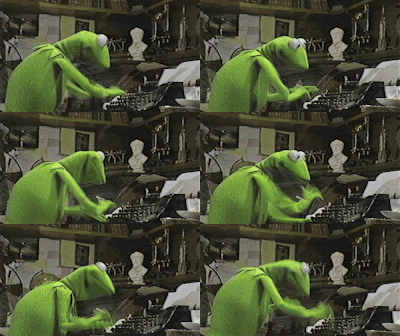
But when you’ve got enough of it in your head, you can just go.

Will it be perfect? Definitely not. But that’s okay, because we’re just doing a first draft.

So get to it.

Next time... should I keep going with the A2Q? Or should we take a break and I could talk about something else for a bit? Let me know what you’re thinking.

Until then... go write.

Write like nobody’s going to see it.

Thursday, December 5, 2019

NaNoWriMo Aftermath

And now we rejoin our ranty writing blog, already in progress.

Hey, everyone. Thanks for sticking with me through the Black Friday stuff and the Cyber Monday stuff and then even more good book stuff on top of that. Hopefully it’s all helped you a little bit with the holidays.

I don’t know about you, but NaNoWriMo is still kinda fresh in my mind. With Thanksgiving right there at the very end of the month, it left me feeling like I’d been kinda cheated out of a week, y’know? More of a NaNoWriThreeWeeks.

I’ll be honest. I didn’t hit my word count goals for the month. By a long shot. I ended up hosting/moderating two Coffeehouses last month and the dystopian book club. Plus a day doing some promo stuff for an upcoming project. Plus my parents came out for Thanksgiving so, y’know, an extra level of cleaning and neatening. All in all... I think I lost close to two weeks. You probably needed to focus on some of them, too, right? I mean, I’m not the only one who had to do work stuffOr holiday stuff.

But I’m okay with it. I still got a lot done, even if not as much as I’d hoped. Also figured out a major narrative issue that’d been nagging at me for ages.

And that’s kinda what I wanted to talk about. Before the month started, I mentioned that “NaNoWriMo” is deceptive because we’re not really trying to write a novel in a month. We’re trying to write a first draft in a month. A rushed, hurried, often truncated first draft.

Thing is... even that’s a bit misleading. Because if the ultimate goal was to get an even slightly passable first draft this month, pretty much everybody would fail. I don’t know what the numbers are, but I’m willing to bet the majority of people who do NaNoWriMo don’t complete a draft. And I’ll go a little further out on this limb (and even hand you a saw) and say I wouldn’t be surprised if half of the folks who do finish have drafts that... well, let’s politely say they’re drafts need SO much work they’re effectively going to be rewriting the whole thing in their next draft. 

And hopefully they at least realize they need another draft.

So here’s my take for you. First, stop thinking about “winning” NaNoWriMo. This was a marathon, and most people don’t run marathons with the sole goal of winning them. Because if that’s my only goal, I’m going to be disappointed. A lot.

Most of us run marathons just to see if we can do them. The goal isn’t to be first—to win—it’s just to see if we can actually make it to the finish line. I don’t know about you, but I’d be friggin' thrilled to finish a marathon, even if it took me three or four hours. Hell, if I could do a half marathon in that time I’d be kinda proud.

That said... point the second. What did I get done during NaNoWriMo? How much did I write? How many words got put down?

Y’see, Timmy, the real goal here is to see how many words I can write in a month. Because now I know how many words I can write in a month. Which means I can do it again this month. And next month? Hell, January’s clear sailing. No holidays, nothing to slow me down. Now I know exactly how long it’s going to take for me to finish that 90,000 word first draft. I have a solid, very attainable goal because I just showed myself how much I can write in a month.

So celebrate finishing NaNoWriMo. Even if you didn’t “win.” Because you won in the way that really matters.

Next time... I’d like to talk about writing as art.

Until then, go write.

And congrats again on NaNoWriMo.

Thursday, October 31, 2019

Ultimate NaNoWriMo Tip

Hey! I know it’s the day of costumes and candy, scary movies and fun photos, and all that sort of stuff. Writing’s probably the last thing on your mind right now. Heck, it might be sometime Friday afternoon when you read this.

Which, oddly enough, is what I wanted to talk about real quick.

As some of you are probably aware, Friday’s also the first day of November, which means it’s the first day of National Novel Writing Month.  People sit down at their keyboard, scoop up a legal pad, put a new sheet of paper in their old vintage typewriter, jam that USB16 plug into the hexadecimal cerebral port behind your left ear, and try to get an entire novel written—start to finish—in just 30 days.

Are you one of said people? Maybe you have been in the past. Maybe this is your first time. It’s my first time. Yeah, I’m going to try to get my current work in progress finished this month. Granted, I’m about 25K into it already, but my hope is to hit at least 100K this month. Yeah, even with the parents coming out for Thanksgiving.

(this will also be my convenient excuse later)

Anyway, lots of people are tossing out NaNoWriMo tips right now and I wanted to offer my own good news/bad news advice for you. More of  a mindset thing. I know it helped me a lot when I finally figured it out.

The bad news is this isn’t going to be a book. Not even close. See, the name NaNoWriMo is kinda deceptive, because we’re not really going to be writing a novel this month. We’re writing the first draft of a novel. Just a first draft. And, as we’ve discussed here a few times, there’s a big difference between a first draft and a polished, completed manuscript. 

And really, we’re writing a rushed first draft.  It’s going to have plot holes and dropped threads and factual errors and punctuation mistakes and typos.  Sooooooo many typos.  Incredibly embarrassing ones. It absolutely will, trust me.  Having a finished first draft is a fantastic starting point, but it’s going to need a lot more work after December first. No question about it.

Very sorry if you had any great plans about this finding an agent before Christmas. I’ve actually heard stories about agents who... well, I shouldn’t say they dread the first weeks of December. Or that they all physically cringe when they see “NaNoWriMo” in the introductory paragraph of the cover letter. But I think it’s fair to say they go into these things with a few strong opinions already formed.

Now, the good news is... well, it’s a first draft. We can stop worrying if an agent or an editor is going to like it because they’re never going to see it.  This draft is just for us to do whatever we want with.  I shouldn’t spend a minute second-guessing what those other people will want to see.  They may see later drafts, sure, but what we’re doing right now? This is just a big bowl full of cake batter. It’s got potential, sure, and it’s kinda yummy as is, but the truth is this isn’t even halfway through the process. There’s so much more that needs to happen before it’s ready to serve to anyone.

So forget ‘em.  Right now we can crank up the music and let our imaginations run wild.  We can do whatever we want.  We can tell our story.  We can drop all expectations and inhibitions and just write. Feel free to mess up, to use the wrong word, to make drastic changes, to leave things blank or marked [FIX THIS LATER]. Don’t worry about critics or agents or book covers or any of that

Seriously. NaNoWriMo is about the first draft so be selfish. Make it all about you and what you want to do. This is, as the youths say, the “dance like nobody’s watching” part of the process, so dance your ass off.  Hemingway said write drunk, edit sober, and well... we shouldn’t be doing a lot of editing this month. Let your creativity off the leash, eat nothing but corn chips, drink nothing but whiskey, run naked in the park, and don’t worry about anyone else and what they may think.  Do what you want to do with this one.  Do anything, free of worry or expectation.  Because this is just a first draft.

Also, don’t actually run naked in the park. You’ll probably get arrested, and that’s going to eat up a big chunk of your writing time.  Plus it’ll end up on YouTube and let’s be honest... unless you’re in really good shape that’s not going to help your career, either.

Although these days, who knows. Dad bod is kinda in with some folks.

You know what? If running naked in the park is part of your process, go for it. You do you. Tell the police I said it was okay.

Anyway, that’s my big NaNoWriMo tip for you.

Next time, I’d like to talk about twists. Really, about what happens before them.

Until then, go write.

Friday, October 25, 2019

Some Outlining Questions

Look! Bonus content! It’s what the internet screams for!

Last weekend I was in Dallas talking to folks about NaNoWriMo. Overall I think it went pretty well. People laughed and chuckled in all the places I hoped they would.

However... there is strong evidence that I may have had waaaaaaaay too much caffeine before giving said talk. Combine that with a very echoey big room and, well, some of my brilliant observations about writing were lost. And most of my awkward jokes, too. So it’s a pros and cons situation.

Anyway, since I’ve been asked about a few things that got lost in my speed-echoes, I thought I could tweak part of the speech and post it here for everyone. It’s helpful for NaNoWriMo, but it’s some good overall stuff to keep in mind, too. Plus, this way I can add in a ton of links to help explain things even further.

What I’ve got below are eleven questions for you to think about when you're sitting down with your story.  Depending on your particular plot/story/genre/cast of characters, there’s a chance one or two of these might not work for you.  But a lot of them should. In fact, I’d say if a lot of these don’t apply to the story I’m trying to tell, I’m probably missing something important.

1) Who’s my main character—or characters, depending? Man, woman, non-binary, young, old, straight, gay, werewolf, vampire, bionic space Pope, who are they?

2) What’s a normal day for them? What would they be doing today if they weren’t falling in love or saving us from vampire kaiju? What’s their day job?

3) What happens to make this not a normal day? What changes in their life? Why are we writing a story about this day & not a day last week or next month? Fancy folks call this the inciting incident or introducing conflict. I just like to say... why is this not a normal day?

4) What are they trying to do? Really simply, what’s my book about? This is their goal.

5) Why are they trying to do it? Fancy people call this “their motivation.” Kidnapped friend? Revenge? The greater good? Nanite bomb implanted in their groin? Why aren’t they just saying screw this and going back to their normal life?

6) How are they trying to do it? What actions are they taking? Do they have a plan? Are they making it up as they go along? We want our characters to do something.

7) What’s stopping them from getting it done right now? Is their goal far away? Under guard? Super expensive? Only dates cheerleaders?

8) Do I have an antagonist? Somebody openly trying to stop my hero, for major or minor reasons. My antagonist doesn’t need to be a villain, but they’re definitely somebody with opposing views.

9) What does my antagonist want? This is another character, so we want to develop them. They’re going to have goals, too, even if it’s just “kill all those kids out at the summer camp” or “stomp across Vatican City once the sun goes down.”

10) Why do they want it? My antagonist needs to have motives, too. So just like with my hero–why are they doing this?

11) Finally, what happens when my hero achieves their goal? Are there parades? Explosions? Bloody vengeance? Long passionate kisses? What happens if everything works out right? And on the flipside, what’s going to happen if they don’t achieve their goal?

Now, again, these aren’t end-all be-all questions. There’s a good chance 1 or 2 of them might not apply to the story you’re telling. But the answers to most of these questions should exist, even if I’m never going to specifically spell them out in my story.

Y’see, Timmy, if I can answer all of these... look at what I’ve got. It means I’ve got characters. I’ve got an established norm. I’ve got an inciting incident. I’ve got goals and motivations and obstacles. And these are the kind of things that form the bare bones of an outline. They should spell out a basic plot and story. If I can answer these, I know I’ve got an actual story.

And if I can’t... well... odds are I’ve got some more work to do.

Hey, speaking of bonus posts, I wanted to toss out something else seasonal on Monday or Tuesday. And then back to our usually scheduled rants on Thursday.

Until then, get back to writing! Go on... write!

Saturday, October 19, 2019

DFW Writers Workshop

     So, hey, if you're in the Dallas area and you're not doing anything tomorrow...


Thursday, April 25, 2019

In The Beginning...

Running a bit late with this today.  Sorry.

So, I’m wading into a new book this month, and I figured... well, that’s probably a great time to talk about getting started and the draft process.

Of course, right off the bat... did I really start it this month?  I mean, sure, about two weeks ago I sat down and started actively working on an outline for it.  But the truth is, this is actually the second outline.  I first pitched it to my agent almost two years ago (and then again to my editor that summer).  They both said (and eventually, I agreed) that it needed some more work.

And, really, the bare idea came almost a year before that.  Back in early 2016, if memory serves.  I know I talked with another author, Kristi Charish, about one aspect of it back then, to get her thoughts and expertise on parts of it.

When do we “start” writing?  When does it count?  Is it when we first start thinking about a project?  When we actually make some notes or an outline?  Or is it not until I write VAMPIRE KAIJU: BOOK ONE by Peter Clines   CHAPTER ONE...?

I think that’s worth mentioning, because whenever I see someone talking about writing a book in five weeks or two months or whatever, I always wonder what they’re counting.  A finished, polished manuscript?  Just the first draft?  Are they counting the time they spent outlining, or that they started mulling it over months—maybe years—in advance?

Paradox Bound came out in 2017, but I pitched it to my editor and wrote up a first rough outline back in 2013.  And Dead Moon, my new one that just came out on Valentine’s Day?  My very first stab at that actually happened back in 2011, right after I finished writing Ex-Patriots.  Yeah, it was a different book back then, but still... when I sat down to “start” writing it in 2017, I already had about 30,000 words done.

So how long did they take to write...?

Again, just think about that the next time you see someone say they wrote something in a short amount of time.  Or in a very long amount of time.  We all have our own thoughts about what counts as starting and stopping points.

Anyway...

At the risk of sounding arrogant, let me walk you through my process.  Well, more of a quick stroll, really.  I’ve talked about a lot of this before (so I’ll add a lot of links), and I don’t want to bore you with it since... well, odds are you won’t be doing things this way.

No, seriously, you won’t.  The process I use is pretty much unique to me.  And the process you use is unique to you—even if maybe you haven’t figured it out yet.  Or you’re in the process of evolving from one process to another.  I’m just showing off mine to maybe spark some thoughts and help you think about such things.

So... let’s get started.

All of this always starts with an idea.  Maybe you’re the type who writes them down, maybe you keep it in your head for a while.  I’m 50-50 on it.  If an idea really sings in my head right at the start, in any sort of way, I always write it down.  But some I mull over for a while.  I let them ferment in my brain, see if they grow a little or get a better shape.

Eventually all these notes come together in some form of rough outline.  I think we all do some kind of outline.  Even the most random of road trips starts with, at the bare minimum, “let’s head west.”  Maybe it’s just a page or two of those rough notes.  Maybe it’s an extensive beat sheet.  It might be a huge stack of color-coded index cards.  This stage is really going to come down to “whatever works for you.”  The outline I just finished up for this project is twelve pages, with another two page document about the characters, but that’s just me.

And now, I guess, we’re ready to “start” writing.

My first drafts are big, messy things.  I write a lot, but I also skip a lot of things.  The only goal with a first draft is to get it done.  Nothing else matters.  Not punctuation, not spelling, not finding the exact right word or crafting the perfect cool line to end that chapter on.  These things’ll matter eventually, but right now... I just want to finish this draft.

NaNoWriMo is really all about this.  It’s pushing yourself to just focus on finishing a first draft, rather than slowing down to worry about individual scenes and chapters.  If you’re especially determined (or masochistic) you could try the 3 Day Novel contest.  My partner’s done it a few times now and... well, I just try to keep her supplied with coffee and stay out of her way.

Once I’ve got this done, I dive into my second draft.  This is me in clean-up mode.  All the stuff I skipped gets filled in.  Sentences I never finished, incomplete descriptions, the places where I had to look up a certain place or name and for now it’s just ######### or [ADD BIG FIGHT HERE] or [MAKE THIS NOT SUCK SO MUCH!!!]

I also take a good look at the things I skipped.  Why didn’t I write it earlier?  Could I not come up with anything to go between these two elements?  Was I just not interested in writing that bit? If I’m not interested in writing it, people probably aren’t going to be interested in reading it.  This might tighten things up right here.

For me. the goal with this draft is to end up with a solid, readable manuscript.  Someone should be able to go to page one to page 500 and never hit any weird gaps or confusing typos or anything else that immediately kills the flow.

Third draft is editing.  I go through the whole manuscript line by line.  I check all my spelling.  I look for repetition and redundancy.  I cut a lot of excess words here.  Thousands of words, usually.  This involves a bunch of passes, the last one to make sure all this random cutting and tweaking hasn’t created any new hiccups.

When I’m all done with this—which can take a week or so—I try to get it in front of a few people I trust.  My partner.  Old friends who've ended up in the storytelling line of work.  People who’ve heard me talk about it and people who don’t know a thing about it.  The important thing is they’re all going to give me honest thoughts and opinions.  Which may sting sometimes, but will be much more useful.

Once I have all these notes from folks, I start my fourth draft.  Now I’m going through all these copies one line at a time, taking notes of my own and implementing changes where they’re needed.  How many people liked this bit?  How many didn’t like that one?  Whoops, guess I missed a comma there.  Now, having been away from this for a month or so while other folks were reading it, that line’s really dumb, isn’t it? Did I actually think that was deep and clever at some point?

This takes at least a week. Often more.  I’m simultaneously reading three or four copies of the book line by line, getting everyone’s thoughts and takes on it.  Weighing their thoughts against my own and each others.  Sometimes it goes fast, other times... it’s really slow.

And this eventually, finally brings us to the fifth draft.  This is me going through the whole thing again to make sure those fourth draft edits didn’t leave anything hanging or tweak a key point.  Just a nice, slow read-through.

One thing I like to do at this point is switch the whole thing into another font.  If I’ve been writing in Times New Roman, I switch it all over to Courier New.  If you’ve been doing that Comic Sans thing, hey, you needed to switch anyway.  When I do this, it makes everything sit differently on the page.  The words look different.  And suddenly passages I’ve been glossing over (after going through this a dozen times) are fresh and new.

And at this point... I wrap it up.  I think it’s important to just say “done” and move on to new projects, or else you can get stuck in an endless trap of rewriting again and again.  After all these rewrites and edits, there’s not much else I can do.

So that’s my process, beginning to end, in a nutshell.

Hey, what do you want?  I just started a new book.  I’ve got work to do.

Speaking of which... next time, I’d like to talk to you a bit about that guy across the street who just said the weirdest thing to me.  See him right over... where did he go?

Until then... go write.

Thursday, November 29, 2018

Next Time, Gadget! Next Time!!

            Wow, November’s almost over.  Where’s this month gone?  Hell, where’s this year gone?  Can you believe Black Panther only came out a little over eight months ago?  Seriously.
            Anyway...
            The end of November also means we’re closing in on the end of NaNoWriMo.  About, what, a day and a half left?  Maybe a little less, depending on when you read this?  I hope it’s going well for you.  I’m sure you kicked ass, but I hope you realize that.  Whatever you got done this month is an achievement.  So many people talk about writing, but you went out and did it.
            How much did you get done?  Thirty thousand words?  Forty five?  Sixty?  Are you one of those inhuman folks who closed in on ninety thousand words (an average of 3000 words a day—I know lots of pros who’d envy that kind of stamina).
            Which brings me to one of the best things you’ll get out of this.
            Let’s say you ended up with 45,000 words.  An average of 1500 a day.  Not a novel, but it’s halfway there, easy.  It’s a good solid novella as is, and there are some markets opening up for that sort of thing.
            But here’s the thing...
            If I did this once, I can do it again.  Those 45,000 words are inarguable proof that I’ve got the ability to produce words at a good rate.  At a professional rate!  Which means I could do it again in December and boom look at that! A ninety thousand word manuscript, if I keep going on the same thing.  That’s a novel.  Any publisher on Earth would call that a novel.
            Are they 90,000 perfect words?  Ehhhh... probably not.  But it’s a very solid first draft.  And if you produced a first draft, it means you’ve got it in you to do a second and third draft.  You can’t deny it.  The proof is right there.
            Even better—you can do it again!  Maybe in March and April.  Keep up that same rate and there’s another 90,000 word first draft.  Hell, maybe next time you’ll be just a little faster.  Now that new manuscript’s 100,000 words long.  One.  Hundred.  Thousand.  Words. 
            And we both know you can do it, because you just did it now during NaNoWriMo.  And you can do it again.  And again.  And again..
            A bunch of times here I’ve mentioned my early attempts at writing novels.  The Werewolf Detective of Newbury Street.  The Trinity.  Even the wonderfully goofy, very early-oeuvre masterpiece Lizard Men from the Center of the Earth.  One thing they had in common was that I didn’t finish any of them.
            Another thing they had in common is that nobody bought them.  Nobody was really interested in them.  Because they were incomplete.  I didn’t have the stamina—or the confidence—to finish them.
            The Suffering Map is the first thing I finished.  It’s the first thing I wrote that made it to second and third and fourth drafts.  It’s also—no coincidence—the first thing of mine that got any interest from agents and editors.
            Did they buy it?  No, of course not.  It’s still awful.  I mean, let’s be honest--it was my first finished book.  There was so much clumsiness in it, on so many levels.
            But I finished it.  So I knew I could finish another one.  A better one.
            And I did.  I wrote my next book in almost a third the time.  Or a tenth, depending on how you want to look at things.  And that book sold.
            Being able to produce words is a huge accomplishment.  Having the discipline to keep doing it is fantastic.  And if you’ve managed to do ninety, fifty, or even just ten thousand words this month, you’ve proven you can do this on a regular basis.
            So, congratulations.  You just won NaNoWriMo in one of the most important ways you can.
            Next time, I thought I’d bounce a couple character ideas off you.
            Until then... go write!

Thursday, November 1, 2018

NaNoWriMo—FIGHT!!

            Hey!  It’s November.  Like, just barely scraping into November.  By hours.  You’ve probably still got the taste of chocolate in your mouth, don’t you?
            Yes you do.  Don’t lie.
            Anyway, if you’re even a semi-regular reader of this site, you’ve probably heard of a certain November writing event that starts... well, probably right about now, depending what time zone you’re in.  Some of you may have been writing for the past hour or two, fueled by miniature Heath bars and Reese’s cups.  Power to you for starting right at midnight.
            On the off chance this is all new to you, I’m talking about NaNoWriMo.  National Novel Writing Month.  You sit yourself down at the keyboard, scoop up your legal pad, jack in to your hexadecimal cerebral port, and try to get an entire novel done—start to finish—in just thirty days.
            And when you finish, you get...
            Well, bragging rights, basically.  Pride.  A feeling of accomplishment.
            Sounds a bit intimidating, yes?
            It sure as hell is. 
            Don’t get me wrong.  It can be fun, recharge your batteries, stoke the fires, and lots of other clever aphorisms.  But the simple truth is, it’s a huge, exhausting undertaking.  I do this full time, for a living, and the idea of writing an entire book in thirty days makes me feel a bit overwhelmed just thinking about it.
            So here’s four quick thing to keep in mind so you don’t get as intimidated or overwhelmed.

            1) Don’t be Hard on Yourself—this is supposed to be fun.  You’re on a deadline, yes, but it’s a self-imposed deadline with no consequences if it’s missed.  Seriously, relax.  Don’t beat yourself up if you don’t make your daily or weekly word count.  That’s the kind of thing that makes you feel bad about yourself and about your ability as a writer.  It doesn’t help anything, it just makes you enjoy the act of  writing less.
            Push yourself, but don’t pressure yourself.  The big goal here is to improve, so any and every improvement counts.  Have fun and enjoy all the little victories this month.  This is a time when coming in second or third is still a great achievement.

            2) Pace Yourself—nobody wins a marathon by sprinting the entire way.  Trying to fill every single waking moment with writing is going to burn you out quick.  And it’ll show in your work.
            Try to be aware of diminishing returns.  A lot of times when I’m on a deadline, I’ll work late into the night.  Sometimes it goes great, but sometimes... I start to slow down.  My productivity drops.  And eventually it hits a point where I would’ve been better off going to bed two hours ago because I would’ve gotten just as much done in half an hour on a good night’s sleep.
            It’s so friggin’ simplistic, but think of the Tortoise and the Hare. Slow and steady gets the worm and the second mouse gets the cheese.  Something like that.  You get the idea.

            3) Rest and recharge—if the last two pieces of advice got together and had an advice baby, it would be this.  Don’t be scared to step away, just for a little while.  Have a nice meal and maybe a drink.  Go for a walk.  Take a nap.  Take a shower.  No, seriously, take a shower.  You should probably do that before going out—you’ve been sitting there for days typing and you’ve got writer stink on you.  Play a game.  Call a friend.  Curl up with somebody on the couch and watch an episode of Legends of Tomorrow or The Chilling Adventures of Sabrina or something.
            Point is, don’t feel bad about stepping away from the computer for an hour.  You’re trying to get a lot done, yeah, but with that in mind you don’t want to overwork the machine to the point it overheats and seizes up.  Give it time to cool down and refuel.  I’m not saying take a day or three off in the middle of this, but don’t be scared to get up, stretch, and walk away from your computer for an hour.  In the end, it’ll run smoother and faster overall.

            4) This Won’t Sell—no, seriously.  It’s won’t.  Kick that idea right out of your mind and stop worrying about it altogether.  It’s just not going to happen.  You’re worrying about your wedding venue and playlist when you’re not even dating anybody right now.
            The name NaNoWriMo is kinda deceptive, because you’re not really writing a novel this month.  You’re writing the first draft of a novel.  Maybe even just the first draft of a novella.  And there’s a huge difference between a first draft and a polished, completed manuscript.
            Most importantly... nobody’s going to buy a first draft.  No agent’s going to look at it.  No film studio will pre-emptively buy the rights after a prolonged bidding war.
            This draft is for you.  It’s to do whatever you want with.  Don’t spend a second second-guessing what those other people will want.  They’re never going to see this.  They may see the third or fourth draft—and be interested in it—but what you’re doing right now?  This is just a mess of cake batter.  It’s barely halfway through the process.
            So forget them.  Right now, just crank up the music and let your imagination run wild.  Do whatever you want.  Tell your story.  Drop all inhibitions and expectations and just write.

            Keep these things in mind over the next couple days.  Hopefully they’ll make things a little easier for you. Which’ll make the writing a little more enjoyable.
            Next time...
            Well, it’s been a while, so I figured we could talk about characters.  Or, to be more exact, who deserves to be a character in my story.
            Until then... go write.