Showing posts with label SDCC. Show all posts

Friday, July 24, 2020

B-Movie Mistakes

If you’ve been following me for any amount of time, you’ve probably caught on to my questionable Saturday viewing habits. Questionable in the sense of “why would someone keep doing this to themselves? And to their liver?”

I’ll sit down with some little toy soldiers to build, put on a movie with aliens or giant monsters or werewolves, and tweet out the occasional observation, critique, or scream of pain. It’s kinda fun, in a masochistic sort of way, and I’m a big believer that you can learn a lot from figuring out where bad things went wrong and how they could be fixed. And I’ve seen a lot of screenplays go wrong over the years. Some I worked on. Some I read for contests. And... some I watched while building little toy soldiers.

Over all this time, I’ve seen definite patterns emerge. The same mistakes happening again and again and again. It was part of what made me start this whole ranty blog way back when in the distant before-time.

And screenwriting is a form of storytelling, which means some of these mistakes—maybe even all of them—are universal. I might not have any interest in writing movie scripts, sure. Not everyone does. But these issues can show up in books, short stories, comics... all sorts of storytelling formats.

So maybe they’re worth checking out.

Anyway, here are my top ten B-movie mistakes, updated a bit since the last time I write them out. Some of it may seem generally familiar. Some of it... well, I’ve found new ways to look at some problems over the past three years.

10) Bad directing
Let’s just get this one out of the way, because it’s the easiest one. It’s also the most universal one. This’ll be a horrible blow to anyone who likes auteur theory, but while there are some phenomenal directors out there, the simple truth is there’s also a lot who have absolutely no clue what they’re doing. None. Yeah, even some directors you’ve heard of.  They have no concept of narrative, continuity, pacing... anything.

This is a killer because ultimately, the director’s the one interpreting the story on the page into a visual story on the screen. Even if they didn’t write the script, the best story can be ruined by a bad storyteller.  How often have we seen a book or movie that had a really cool idea or an interesting character and it was just... wasted?

Because of this—random true fact—whenever you see a horrible story on screen, it’s always the fault of the director and producers. Never the screenwriter. The only reason scripts get shot is because the director and producers insist on shooting them. If it was a great script and they butchered it—that’s their fault. If it was a bad script and they decided to shoot it anyway—that’s also their fault.

9) Showing the wrong thing
This kinda falls under bad directing, but I’ve seen it enough times that it really deserves it own number. Sometimes a story keeps pushing X in our face when we really want to see Y. Or Z. Sometimes the story calls for Y to be the center of focus, but we still keep putting X on camera. And sometimes there’s no need to see X at all—we understand it through dialogue and acting and other bits of context—but we show X anyway.

A lot of this is a general failure of empathy—the filmmakers aren’t thinking about how the movie’s going to be seen. I’ve also talked a couple times about subtlety, using the scalpel vs. the sledgehammer, and that’s a big part of this, too. Sometimes there’s a reason we’re seeing a lot of nudity or a swirling vortex of gore, but all too often... it’s just because the storyteller doesn’t know what else to show us.

8) Bad action
Pretty sure we can all think of an example of this. The almost slow-motion fight scenes that feel like they filmed the rehearsal. The medium-speed chase that drags on waaaaaay too long. The pointless shoot-out that clearly wasn’t thought through since everyone’s standing out in the open.

Action gets seen as filler a lot of the time, and it doesn’t help that a lot of gurus teach it that way. “Hit page 23—you need an action beat! Hit page 42—another action beat!” There’s absolutely nothing wrong with action, but bad action is particularly bad in the visual storytelling format of movies. Unnecessary action isn’t much better.

Think of scale, too. It’s always better to have a small, well-done action scene than a sprawling, poorly-executed one. We can relate to two people fighting so much better that two gangs of sixty people each slamming together. Especially when it’s supposed to be two gangs of sixty members each but there are maybe eight people on screen. Moving in slow motion.

7) Too Much Stuff
Remember when we were young and there was that one kid (we all knew this kid) who got so excited to be Dungeon Master? And he made that awesome dungeon with five liches and a dozen displacer beasts and twenty gold dragons and thirty platinum dragons and fifty minotaurs all wearing +3 plate armor and using +5 flaming axes and a hundred zombies and Demogorgon and half the Egyptian gods and...

I think we’ve all played that game, right? Let’s be honest... maybe some of us were that kid?

Some B-movies get like that.  The filmmakers have too many ideas—way more than their budget or schedule allows—and they try to stick everything into the story.  Every cool idea from every other cool story, sure to be just as cool here, right? Truth is, they almost never are.  All these extra ideas just end up being under-developed distractions at best. 

6) Killing the wrong people
There’s always going to be collateral damage in certain types of stories. Thing is, by nature of being collateral damage, the story doesn’t focus on these people and their deaths don’t really register.  And they shouldn’t. That’s what collateral means after all—they’re secondary. Not as important. But in the tight, compressed nature of a movie, we need these deaths to be important. They need to serve a purpose in the story, hopefully on more than one level.

I’ve talked about the awful habit of introducing characters for no purpose except to kill them.  We meet Phoebe, get three or four minutes of backstory and bam she’s dead without moving the plot forward an inch. Because Phoebe wasn’t really part of the plot, she was just there to wear a bikini top and let the FX crew show off their new blood fountain.

The only thing worse than this is when it’s time for the ultimate sacrifice... and my hero doesn’t make it. A minor character steps forward to throw the final switch or recite the last words. And the “hero” sits back and watches as someone else saves the day.

5) Wasting Time
This one’s the flipside of point #7. I just mentioned that in the limited space of a movie script, everything needs to serve a purpose. If that touching backstory linking two characters doesn’t affect the plot or story somehow, it’s just five minutes of filler I could’ve spent on something else... like the plot or the story. If these shouted arguments don’t somehow reveal something key to the progress of the movie... they may just be a lot of wasted time.

One of the most common time-wasters in B-movies is the unconnected opening. It’s when the first five or ten minutes focus on a group of characters we’ll never see again, usually never even reference again, and who have no effect on the rest of the plot. Honestly, I don’t think I’ve ever seen one of these openings that couldn’t be cut, and I’d guess 83% of the time the whole movie would be stronger—on many levels—without it.

4) Not knowing what genre my story is
I’ve mentioned a few times that I worked on a B-level sex-revenge-thriller-sequel where the director thought he was making a noir mystery. I’ve seen horror films done as sci-fi and fantasy movies that were done as horror films, and vice versa.  Heck, I’ve written stories where I’d planned it as one thing, and realized halfway through it was something very different.

I've talked about genre a lot over the past few weeks, so I won’t go into it much more here. To sum up quick if you don’t want to hit the link, all genres have certain expectations when it comes to tone, pacing, and even structure.  If I’ve got a story in one genre that I’m telling with the expectations of another, there’s going to be a clash. And that clash probably won’t help my storytelling.

3) Plot Zombies
All credit to A. Lee Martinez, creator of this wonderful term. Sometimes, characters do things that are unnatural for them just to further the plot. The brave person becomes cowardly. The timid person does something wild and unpredictable. People argue and storm off for no reason. Well, so one of them can get murdered by the monster after going for a calming nighttime swim in the lake, but past that... no reason.

Plot zombies just stumble around a movie, doing whatever the story calls for. They don’t have any personality or agency, and really, one plot zombie’s pretty much the same as any other plot zombie. If I have an inspiring speech or an act of wild abandon or a last minute moment of brilliance, and there’s no reason I can’t swap all the characters around in it... it means I’ve got plot zombies.

2) Horrible dialogue
Bad dialogue always makes for bad characters.  If we can’t believe in the characters, we can’t believe in the story.  If I can’t believe in the story... well, that’s kind of it, isn’t it?

So many movies have painfully bad dialogue. Pointless arguments. Annoying characters. Awful technobabble.  And sometimes—too much of the time—it’s just bad.  It’s lines that sound like they went back and forth through Google translate and then the actor’s seeing them for the first time on a teleprompter while they’re filming.

Personally, bad dialogue drives me nuts, because it means the storytellers have no idea what human beings sound like. It’s a massive failure of empathy, and that empathy almost always shows up elsewhere. I’ve never, ever seen a story with bad dialogue that excelled everywhere else. It just doesn’t happen.

1) Who am I rooting for?
This is still the number one killer in America. This is what brings so many B-movies—so many STORIES—to a gear-grinding halt. 

So many movies have absolutely no likable characters. Everyone’s self-centered, obnoxious, stupid, or arrogant... or a combination of these traits. They’re all awful, sometimes disgusting people. All of them. The bad guys and the good guys.  People start dying and I’m always glad, no matter who they are.

If I’m expected to sit here and watch this for ninety minute, I need a reason to follow someone besides “they’re the main character.”  I need to like watching their story play out. I need to be able to identify with some aspect of their personality. The movie needs to have someone I actually care about. ‘Cause if it doesn’t. I won’t care if they win or lose. And if I don’t care about that... well... I’m not going  to be sitting here for ninety minutes

And that’s my personal, current top ten B-movie mistakes.

Hey, speaking of movies... this Saturday I’m doing my usual Saturday geekery, but for SDCC @ Home I’m doing it as a watch-along party. Come hang out on Twitter starting at noon (PST) with Krull, followed by the Keanu Reeves Constantine at 2:30, and finishing up the day with Resident Evil at 5:00. It’s going to be fun and maybe a little informative. Plus there’ll be a couple other folks chiming in with the #KrullKon2020 hashtag, and even a few giveaways.

And next time here, I thought I’d talk a bit about editing this new book.

Until then... go write.

And maybe enjoy a movie or three.

Tuesday, July 21, 2020

SDCC @ Home

In the before time, this would be the day I pack up and drive down to San Diego to beat the traffic. I’d crash with some friends, play some games, watch a movie, have a drink or three, and then tomorrow would begin the fun logistical nightmare that is San Diego Comic Con.

Of course, I moved to San Diego, and last year I found out how much easier some aspects of SDCC are when you can just walk a few blocks and hop on the train to downtown. And now that I’ve worked out the kinks, this year should be...

Oh. Right.

While SDCC is technically not happening, the folks behind it are trying to bring a lot of it home to, well, everyone. Panels and programs are getting released online, and you can spend the next few days watching and learning. Plus a lot of side things are going on directly from vendors, publishers, and even some creative folks like me.

For example...

Friday at 4:00 (PST)on the SDCC YouTube Channel, I’m going to be on a panel with Kiersten White, Henry Herz, and Fonda Lee as we talk about creating worlds, characters, and conflicts as sci-fi and fantasy writers.

Saturday at 12:00 (PST) on Twitter, I’m going to be hosting an unofficial geekery watch party with a couple author friends and a trio of great B-movies to comment on. Krull. Constantine. Resident Evil. We’re going to watch them all, talk about why we love them, the things they do really well... and some of the thing they don’t. Plus, there’s going to be some giveaways from Audible (seriously) and tons of celebrity guests (no, not seriously... probably).

Sunday... well, normally we do some version of the Writers Coffeehouse at SDCC. As some of you know I’ve been trying to get it going again as an online Q & A/ discussion, where I ask a bunch of writer friends to help answer your questions about writing. There’s already a few episodes up on my own YouTube channel, and on Sunday I’m going to put up a lot more. So hop over there and get answers from Django Wexler, Kristi Charish, A. Lee Martinez, ML Brennan, Stephen Blackmoore, and more.

And all of this for the low, low price of absolutely free, delivered to you right there on your couch as you safely physically distance and do your part to help get Covid under control.

Enjoy.

Thursday, July 18, 2019

Unconventional

I'm at SDCC right this very minute.

Even if you're reading this three weeks from when it posted.  I'm still at SDCC.

Send help!  Please!


Wednesday, July 17, 2019

SDCC 2019


So, I'm only at SDCC for the one day this year. Slim chance you might catch me wandering on Saturday, but I think Thursday's probably going to be it. Very sorry if you don't get there until the weekend.

Also, I may be scribbling in some books at the Del Rey Booth (#2913) Thursday morning-ish, just so they'll have signed books to sell.  If you happened to be there at the same time, you could say hi or get a book personalized or what have you. Follow me on Twitter and I'll let you know when I'm heading over to the booth.

See you in San Diego!

Thursday, July 11, 2019

In A World... Where...

Yeah, there was no post last week.  Holidays, finished editing, all that. I know I promised you a post about computers, but when I re-read it felt rough.  I toss around some touchy topics in it, so rather than risk saying something that could get easily misinterpreted. and set off a bunch of people yelling... I just figured I’d let it sit for now. Maybe I’ll get to it some other time, or bring it up at one of the many Coffeehouses in the future.

But I gave you two this week to make up for it. Okay, so one of them was the updated FAQ, but it’s still an informative post.  Just maybe not the information you were hoping for.

So, one thing I’ve mentioned here once or thrice is the idea of believability. On some level, we need to accept this character or world as real, because that’s how their stories become real to us.  If a character or a world asks us to accept too much... well, we just can’t.  One too many coincidences or secret cults or hidden talents and... we’re out.  That willing suspension of disbelief gets shattered.

Of course, what’s “believable” is kind of tricky, isn’t it? I mean, we completely accept  a tavern with fifty different alien races in it when we’re watching a Star Wars movie.  But if I’m reading the latest addition to the Their Bright Ascendancy trilogy, well... that doesn’t work quite as well. And if this was an episode of Elementary or even iZombie we’d just roll our eyes and talk about the days back when this was a good show.

(they’re both great shows, just to be clear—but not if they suddenly had alien bars in them)

When we start to get invested in a story, part of it is that we get a good feel for what kind of world this story is set in.  Does magic exist?  Or aliens?  Does everyone know about vampires or are they still living quietly in the shadows, unknown to the average person? Assuming they’re even real.

A big problem I stumble across on a semi-regular basis is when a writer tries to change the world too late in the story.  We’ve been reading about a story set in the real world and suddenly there are goblins and vampires.  Or it turns out we’ve all known about aliens since the ‘50s.  I mean, we teach about them in school.  In history class!

I was reading a book lately that was set in Victorian London (locations, names, and/or supernatural beings may have been changed to protect the relatively innocent). A take on “the great detective” trope, but it was fun and had a nice mystery aspect to it (hunting a Jack the Ripper-esque serial killer) and the dialogue and descriptions of London were just fantastic.  I was really enjoying it.  Until...

A little more than halfway through the book, maybe close to 60 or 70% in, we find out that the serial killer is actually the Frankenstein Monster, gathering parts for yet another attempt at electro-alchemically creating a mate for himself.  It just came out of nowhere  Not so much a twist (it wasn’t really set up) as a weird reveal.  And it kind of... well, it knocked me out of the story.  It was a cool idea, but suddenly this was a very different world than I’d been led to believe. The type of characters who could be in it had drastically shifted. I had to reconsider a lot of things, and one of the biggest was “does this story still make sense?  Is this world still believable?”

Needless to say, I had to readjust my expectations as far as where this story sat on the plausibility/believability scale.  Which meant I then had to go back and reconsider everything that had already happened.  Were all those earlier moment still believable, now that I knew they were happening in this world?

And this isn’t to mean I came to a dead stop and started checking things off in a plus or minus column. It was just one of those moments where an instinctive reaction forces everything up into my brain.  I stopped enjoying and started analyzing. I was much more in my head for the rest of the story.

It’s kinda like wandering through a pool on a hot day. You may be really enjoying the cool water, the feeling of being outside, being with friends, all of it.  It might feel fantastic. But then you hit a spot of water that’s just a little warmer—just that certain amount warmer—and now that one small-but-significant change has made you very aware of the pool.  Who else is in the pool. Where are they?  Where were they?  Now you’re not so sure if the pool’s a great place anymore. Sure, it may be nothing, but it’s kinda in your head now, how much water is on your skin.

And that’s a small change.  Imagine if you bumped up against a dead rat in the pool.  Or a shark. How the hell is there a shark in the pool?  Was it there all long?  Was it invited to this party, too? Is it responsible for the warm spot?

We need to feel comfortable in the world of the story.  I don’t want my readers to feel confused or betrayed. Bruce Joel Rubin made a wonderful observation years back that we experience stories in our gut, but we analyze them in our head.  So the moment we go into our head, trying to figure out what’s up with that warm spot, we start to lose our readers.

If I had to put a loose rule to it, I think any serious world-change like this has to be the end of act one/start of act two moment.  It’s part of the easing-in process.  The Matrix.  Red Rising. Harry Potter.  In all of these stories, the discovery that the world was than what we'd first been led to believe comes fairly early.  It’s probably notable that it’s also what gets all these stories really going.  This discovery is, arguably, the inciting incident, as folks have been known to call it.

Now, this moment can come later, sure.  I’m betting everybody reading this knows at least three or four “We were on Earth all along” stories.  But when these stories work—and that’s kind of a rare thing if you think about it—it’s because this is a very carefully set up twist.  And like any good twist, it’s been set up so the big reveal makes things fall perfectly into place rather than scatter across the table and spill onto the floor.

I’d also add that just because we’re flexing that suspension of disbelief with one thing doesn’t mean another thing will slide off with no problem. Finding out the serial killer we’re chasing is Frankenstein doesn’t mean we’ll also accept that he leads a taskforce of steampunk cyborgs that protect the earth from alien invaders.  Just because there are vampires doesn’t mean I’ll buy that Abraham Lincoln really was a vampire hunter sanctioned by the Vatican.

So if halfway through my story I’m introducing an element that’s going to change how readers look at my world, I should take a good, long look at it.  How big of a change is it?  Is it very late in the story?  Is it coming out of nowhere?

Is it necessary?

Oh and hey, speaking of the Writers Coffeehouse (as I did way up above), there’s one this Sunday, noon to three, at the new Dark Delicacies in Burbank. There’s also going to be one at San Diego Comic-Con, one week from today, from 2:30 to 4:30, and that one’s going to have me, Jonathan Maberry, Delilah Dawson, Scott Sigler. and maybe some other folks, too.  Come hang out with us and talk about writing. Plus I'm also doing the dystopian book club at the Last Bookstore this Sunday, too.

Next time... well, next time is Comic-Con, like I said. I probably won’t have a post up next week, but I may have a few fun cartoons and such if you want to check back in.  And then maybe the week after that I’ll blab about cool camera shots.

Until then... go write.

Monday, July 16, 2018

SDCC Schedule

            Hey, folks.  As you may have heard, there is this celebration of the popular arts down in San Diego this week.  A convention, of sorts.  Some of you may be planning to attend.  I’m going to be there, too, and if you wanted our paths to cross, well... I figured I’d tell you where to find me.
            As it happens, though, this year all my events for San Diego Comic Con have fallen on the same day.  So I’m pretty much going to be there for Thursday and... well, that’s it.  I may wander around a bit Friday, possibly duck in Wednesday night to get one of the cool Beebo bags.
            But really, your best chance to find me is going to be on Thursday.

12:00
Signing – Crown Publishing Booth (#1515-J)
            This is just a little unscheduled thing as I scribble in copies of Paradox Bound for the Crown folks.  Please feel free to stop by, say ‘hullo,’ and pick up a book for me to personalize for you.  It is informal, so I’ll probably only be here for 20 or 30 minutes.

2:30
Writers Coffeehouse 
 (Santa Rosa Room at the Marriot)
Come hang out with me and Jonathan Maberry (author of Glimpse, Mars One, and many others) as we talk about a lot of publishing-related topics, answer questions, and generally just chat in a very casual way.  It’s a two-hour version of the three hour Coffeehouse we each host in LA and San Diego (respectively).  Which means it’ll be fun, informative, possibly a little silly, and Jonathan and I will tell

5:15
Signing –Mysterious Galaxy Booth (#1119)
            After the Coffeehouse I’ll be here signing… well, everything at the Mysterious Galaxy booth until 6:00.  I mean everything.  I think they’re going to have a ton of my books, but I’ll be signing in other books, too.  Lots of other books.  Everyone else’s books.  You can finally get that signed copy of Ready Player One you always wanted…
           
            That’s pretty much going to be me at SDCC this year. Hopefully I’ll see you there, and maybe we’ll get to talk for a bit.
            Until then... go write.

Thursday, July 12, 2018

I Don’t See Color

            I know, I know.  Asking-for-trouble title on this one.  Please just stick with me, though, okay?  There’s a good reason for it.
            Which I shall explain with this shocking revelation and a quick story.
            When I was in seventh grade, I found out I was color blind.  This may seem like a weird thing for someone to “discover,” but it makes sense if you think about it.  I’m daltonic (or deuteranomalous if you want to get super-specific), which means I can see most colors, but I have trouble with reds and greens.  I just kind of learned by filling in the blanks. 
            For example, leaves, Sleestaks, and the Hulk were green.  Grass is the same color as leaves, therefore grass is also green. The Lizard is the same color as the Hulk, therefore the Lizard is also green.  I just matched things up with what I learned from books and comics and Sesame Street.
            In other words... I learned just like everyone else did.
          Of course, it never occurred to me that what I was seeing might not be what everyone else was seeing. Why would it?  My vision was perfectly normal.  Nothing made this more clear than several determined childhood attempts to manifest either X-ray vision or optic blasts.
            (and maybe teen attempts)
            (...okay, last week)
            Then one day I got to Science class and the teacher had a slide show set up.  It was a bunch of those pictures-hidden-in-colored-dots things (an Ishihara test, if you were so interested).  Like that one right down there.  And much to my surprise... I couldn’t see anything in them.  Almost two-thirds of them looked blank.  Just like that one down there.  I can’t see anything in it. No pictures or patterns or anything.  If you can, feel free to say something in the comments.
            Anyway, I had a low-level, seventh grade freak-out about all the important stuff—Will I still be able to get a drivers license?  Will I have to get glasses?  What girl will ever want to kiss me knowing I’m color blind?!
          Once that was done, I spent the next day or two re-examining my whole world.  What did Sleestaks really look like?  That “grass is always greener...” thing had always seemed stupid to me, but did it make sense to everyone else?
           And that’s when it suddenly hit me.  How did everyone else see the world?  What was I missing out on?  I mean red, white, and blue Captain America looks really good to me, but how much of that was being told for most of my life that red, white, and blue were complementary?  How did everyone else see those red stripes?  I couldn’t imagine a “new” color that could fill that slot.  Would most people be horrified at what I saw?
            I spent weeks pondering this.  What were other people seeing?  How were they experiencing the world?  If red was the color of anger... was their anger different than mine?  Their envy?  What would alternate-green envy be like?  I was honestly second-guessing everything (which, granted is what most of seventh grade is, but this was on top of the usual stuff).
            Anyway...
            Once or thrice here I’ve talked about empathy.  Really simply, it’s the ability to understand what other people are going through.  If your friend has a hangover, goes through a bad breakup, or saves a bundle on car insurance with Geico, these are all experiences we can relate to, and we can apply how we felt to guess how they’re feeling.
            But really, empathy goes beyond that.  I still have both of my parents, so I didn’t know what it was like when one of my friends lost his.  But I could extrapolate from how I feel about my parents and from huge losses I have suffered.  Empathy’s being able to relate to people even when you haven’t directly experienced what they have.
            I’ve never had that ice-water in your spine moment what I realized I’m sitting in an office with a serial killer. I’m guessing most of you reading this haven’t, either. But our job is, quite literally, to convince people we have.
            Y’see, Timmy, I don’t think it’s exaggerating to say I can’t be a good writer if I don’t have empathy. If I can’t see the world through the eyes of different people—not how I think they see the world, mind you, but how they see it—I can’t have good characters.  And without good characters...
            Well, you know.
            Next week is... oh, holy crap, next week is San Diego ComicCon!  And I’m going to be there next Thursday, hosting a Writers Coffeehouse with Jonathan Maberry (he of Glimpse and V-Wars and the Joe Ledger books).  Plus I’ve got a couple of signings scattered through the day.  I’ll put up a schedule very soon.
            And next week, for the rest of you...
            Well, I’ll come up with something.
            Until then, go write.

Thursday, July 5, 2018

Feeling a Draft

            Okay, yeah. That’s a friggin’ lazy title.  
            I’m pressed for time.  Sorry.
            Why am I pressed for time? Well. I’m trying to pack up my apartment (and my office), while at the same time finish a final polish on this book and write the ranty blog and prep for a Writers Coffeehouse this weekend and holy crap San Diego ComicCon is in two weeks.
            Now that I think about it, it’s kind of amazing how well I’m keeping up with this...
            Anyway, while you read this I’m finishing a draft of my current project and it struck me that I haven’t talked specifically about drafts in... well, a couple of years now.  So it’s definitely a topic worth revisiting.
            Some people hate doing drafts.  Others get caught in this endless loop of writing and rewriting and rewriting and rewriting and...well, you probably know someone like that. And there are folks who skip "drafts" altogether, convinced their words are NYT bestselling gold the minute they’re set down.
            What I wanted to do here is sort of a step-by-step guide of what I do to get something to the point that I’m willing to turn in to an editor.  And by “editor,” I mean “someone who will give me money for these words I’ve written.”  This is final step stuff. Here be dragons. If you think of editors as scaly, fire-breathing folks.
            Of course, all that mother of dragons stuff being said, it’s important that we all remember the Golden Rule


            I’ve mentioned once or twice or thrice before that we all have our own methods of writing.  Doing drafts this way helps me a lot, but it’s not a guarantee of success for anyone except me.  You might need to modify these steps a bit.  Or a lot.  But all things considered, I think this is a good base to start from.
            So...
            Here’s what I do.
            While I’m working on a book, I’m usually scribbling down random thoughts about the next book.  Characters, dialogue, action moments, reveals... all sorts of different elements.  I’ll shuffle these around into more or less the order I think they’ll end up.  Over the past two years or so, I’ve become a bigger fan of outlines than I used to be, but not enough that I’d say “This is the one and only true way! Bow before your meticulously outlined god!!!!”  I shuffle things around, maybe plan a few extra beats, and get a sense where I want to start and where I’m going.
            Once I’ve got all that and the current project is done, I dive into...

            Draft One—So, for me, this is the “just finish it” draft.  I just want to this draft to go from beginning to end with... well, most of the points in between.  I don't worry about typos or crafting nuances here.  It’s just the “plow through and get it done” phase of writing.
            At this early stage, I don't hold anything back.  I let dialogue, descriptions, and action scenes run on a bit longer than they probably should.  I know I'll be cutting eventually, so there's no reason to worry about length now.  For this stage, it really is quantity over quality. 
            Also, like I hinted above, if I get stuck on something at this point... I just skip it.  Seriously.  My first drafts look like old silent movies with the little “Scene Missing” card that pops up for twenty or thirty seconds. I know I’ll be able to go into the exact details of that conversation or this sequence later, so I'd rather keep moving forward and leave that stuff for Future Peter to deal with.  Again, for me, the most important thing is to get the overall framework done.  It's a lot easier to think about the little things when the big things aren't looming over you.
            Depending on the book, this process takes me anywhere from two to three months. I had one book take about six weeks, but that was pretty rare for me.  If I factor out the time I lost to some personal stuff, this last one was just over three.
            A key thing to remember.  I don’t show this draft to anyone. Not my girlfriend, not my agent--nobody.  The first draft isn’t meant to be seen, it’s just meant to give me something to work with
            I may work on something else for a day, maybe even take the whole weekend off, and then it’s right back for...

            Draft Two—So, all those problems I left for Future Peter to deal with?  I’m him now. Those need to be dealt with.  Gaps get filled in.  Characters get fleshed out a little more, and sometimes renamed.  All those awkward knots get worked out.   Now that I can see a lot of these elements in relation to the whole story, I'll usually find the answers to these problems are more apparent. 
            The goal with this draft is to have a readable manuscript.  No more little notes to myself  or trailing paragraphs that need to get connected somehow.  Someone should be able to pick this up and read it start to finish without thinking they lost a few pages or only got my notes on a chapter.
            Again, keep in mind—this doesn't mean I do show it to people.  It just means I should be able to. 
            For some writers, this would really be their first draft.  That’s one of those personal preference things—again, advice over rules.  Personally, breaking it up like this takes a lot of pressure off me, and I think that’s a good thing when you’re trying to treat writing like a real job.  No one likes a high-pressure job.
            Okay then, so... now I step away for a couple of days.  Maybe as much as a week.  I’ll watch movies, work out a little more, maybe even scribble up a few of these ranty blog posts in advance.  The goal is to push the manuscript as far out of my mind as possible.  Don't look at it, try not to think too much about it. 

            Draft Three—And now, the long night of a thousand cuts begins.  Two great rules-of-thumb I've mentioned a few times—

one adverb per page, four adjectives

2nd draft = 1st draft - 10%

            Yeah, the second rule (courtesy of Stephen King) goes off the previously mentioned assumption that my first clean, readable draft is my first draft.
            I spend this draft tracking down adverbs, adjectives, pointless dialogue descriptors, and so on.  One thing I also go after here is common padding phrases that don't really do anything (sort of, somewhat, kind of, more or less).  One of my regular beta readers dubbed this somewhat syndrome a while back, and I still call it that.  I like to tell myself I’ve gotten better about it now that I’m aware of the problem.
            Hey, we all have the little lies that get us through the day.
            And this little stuff adds up fast.  In my current manuscript I cut 200 instances of that. Almost a full page gone, just by checking on one word.
            Again, to be clear, though—these are rules of thumb. They’re guidelines.  I want to stick close to them, but there’s going to be times I want a couple adverbs and a good double handful of adjectives. No editor will freak out if there are three adverbs on one page. But if there’s four or five on every page... well...
            At this point I've gone through the whole manuscript at least twice, so a few larger cuts should be apparent, too.  Overcomplicated descriptions that slow down the narrative.  Awkward sentence structures.  Extensive character moments that add nothing to the character, the story, or the plot.  Many of these things get tightened or cut in this draft.
            I spend a week or two doing this. 

            The Fourth Draft--This is the first big polish.  I go through sentence by sentence, looking for words that come up too often or stilted dialogue.  I also make sure all the cuts and swaps from the last draft haven't messed anything up.  Are the logic chains still complete?  Did I forget to change Gilford’s name to Gillyman anywhere?  Does Gordon have a pistol or a baseball bat in this scene?  Are there any odd character tics that I forgot to remove or add?  Does the whole thing have a good flow to it? 
            This draft doesn’t take long.  Just a day or two.  It’s just one slow, careful read of the story. And, yeah, sometimes I still miss stuff.
            Once I’ve got this clean draft, I send it off to my beta readers to get fresh eyes.   I generally use four or five friends I’ve know for years.  They're all professional writers and editors who know how to give useful criticism.  Not to beat a dead horse, but by professional I mean... they have actual credentials.  Some folks may decide to hire a professional editor at this point.  Nothing wrong with that.  The important thing is to get an unbiased opinion I can trust, even if I have to pay for it. 
            A few folks might argue that editing is the publisher’s job.  Okay, sure, you could look at it that way.  I need to get a publisher first, though, and why are they going to bother acquiring my crap manuscript that wasn’t even edited?
            Anyway... this draft goes off into the world and it may be a week or three before I  look at it again.  For me, at this stage in my career, it usually depends on deadlines.  But I don’t look at it during this time.  I try to relax a bit, scribble down ideas for later books (see above), or flex different mental muscles.
            For example, as I mentioned before, right now I’m packing up a lot of my office.  Turns out I've got a ton of LEGO and Warhammer and Gundam models and comics all piled up in the closet here.  Who knew?
            Well, okay.  I kind of suspected...

            The Fifth Draft—So, I've gotten notes back from those wonderful folks I begged/ blackmailed/ paid to read this thing.  Now I go through the whole manuscript page by page with their comments.  At one point I did this with multiple monitors.
            So, page one... what did everyone think?  What about page two?  How's page three look?  This way I can see all the notes at once and make whatever changes are required.  I've also got my own copy of the fourth draft that I’m slowly rewriting into the fifth draft as we go.
             I mentioned I ask four or five people to make notes for me.  That gives me a broad sampling on each note/ issue that comes up.  If four people like something but one doesn't, odds are I'll call that good.  Nothing’s going to work for everyone.  If three don't and two do (and of course I do—that’s why I write it), I'll sit and give it a good look.  If nobody likes it, well... I'm smart enough to admit when I've screwed up and something doesn't work.
            This draft can take another two weeks or more to finish with a full book manuscript.

            The Sixth Draft-- This one's another polishing draft, just like the fourth.   I need to make sure everything still works now that I’ve made those changes and tweaks from my reader's comments.  So, yet another line by line reading, adjusting as I go.            And at this point... this is when I’m done.  There’s only so much a given writer—in this case, me—can do with a given story.  There comes a point when further work accomplishes nothing and I’m just rewriting for the sake of rewriting.  If my manuscript’s not ready for a publisher (or film producer) by now, it probably means I screwed up something big right at the start

            Next time... well, if there’s anything next week it’ll be really quick. As you may have figured out, I’m moving, and the big day is a week from today.  And then the week after that is San Diego ComicCon!  Oh, hell-- and the Writers Coffeehouse is this weekend.  If you're in LA,stop by Dark Delicacies noon to three on Sunday.
            But, yeah, next time... I’m sure I’ll have something
            Anyway... go write.

Thursday, July 27, 2017

Pixar's Rules of Storytelling, Pt. III

            Hey!
            I’m still getting caught up after SDCC (thanks so much to all of you who said ”hi” at one point or another), so I figured I’d take this opportunity to finish off Pixar’s rules.
            Next time—I want to talk about a bully trick.
            Until then, go write.
            Once you finish reading the rules.


Tuesday, July 18, 2017

Pixar's Rules of Storytelling

            I’m off at San Diego Comic Con all week, doing all sorts of stuff, but I still wanted to have something here (I’m assuming not all of you are going to be at SDCC with me).  So I figured I’d roll out something I’ve been saving for a special occasion...
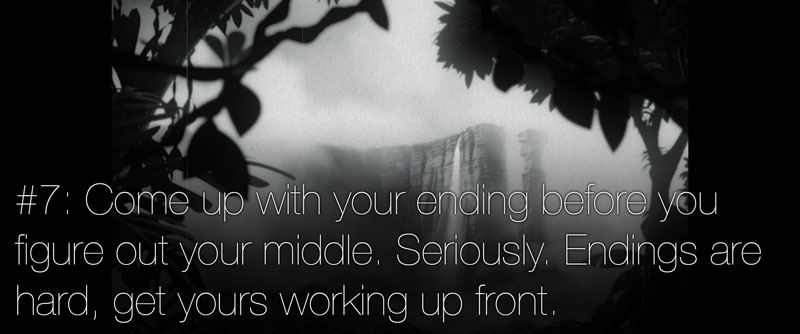
            A few years back, a story artist at Pixar named Emma Coats took all the various tips and hints and suggestions she’d heard during her time there and boiled them down to 22 rules.  I’ve seen them presented a few different ways over the years (including a free poster available on Pixar’s website), but this particular one struck a chord with me—somebody memed them.
            (And I’m ashamed to say I don’t know who.  I first ran into them on a website, but an image search just turned up... a lot of websites.  So if anyone can figure out who actually deserves credit, please let me know...)
            If you happen to be at SDCC, please find me somewhere and say “hi.”
            If not—here’s some rules for you...