Showing posts with label setting. Show all posts

Wednesday, December 23, 2020

It's Not Christmas Without...

And here we are, at that wonderful time of year when a young man’s thoughts turn toward... Nakatomi Plaza.

I wanted to do a holiday-ish post, and then (while watching a favorite seasonal movie) it hit me I could address a fierce debate that’s surged up over the past few years. And maybe I could even make it semi-educational. From a writing point of view.

Is Die Hard a Christmas movie?

Now, let’s be honest. If you’ve got strong opinions about this, I’m not going to change your mind. But if you're somebody who cares a lot about stories (and if you’re reading this, I’d guess there’s a semi-decent chance you are) maybe this week’s little ramble will make you look at Mr. McLane’s late December adventure a little differently. And maybe some other stories, too.

With that disclaimer out of the way... let’s start by talking a bit about the difference between an element and a genre. I’ve mentioned this before, so I won’t go into it too much. Simply put, there are a lot of labels we can slap on both story elements and genres, but the presence of one doesn’t automatically create another. For example, there’s a strong romance element in Bloodshot, the Vin Diesel movie that came out earlier this year. It’s also got a few funny moments. But I don’t think any of you would be surprised to learn Bloodshot isn’t considered a romantic-comedy. Romance, comedy, suspense, mystery, horror, sci-fi... all of these things can be in a story that’s not in that same-named genre.

So let’s talk about Christmas as an element and as a genre.

As an element, Christmas can be a couple things. Easiest is the setting—it’s a specific timeframe that pretty much everyone on Earth knows and can understand to some extent, even if they don’t celebrate the holiday themselves. Also worth noting that Christmas is one of those (if you think about it) rare holidays that has a very fixed date, unlike lots of other that slide around the calendar a bit each year.

Christmas is also in the details and descriptions. Christmas trees, wreaths, presents, garland, lights, a Santa on every corner and a snowman in every yard. These are things I can mention in my story (or show in my movie) and they create an immediate association for people.

It’s also a mood, and a lot of traditions. If I’ve got a story set at Christmas, it’ll probably show up in dialogue. Let’s face it, people interact and talk a little differently in December, no matter which way they feel about any particular holiday. Scrooge is a little nastier. That super-peppy woman at the coffeeshop is almost scarily happy and peppy.

I think there’s a lot of movies and stories out there that get marketed as Christmas tales, but really just have a few random elements tossed in. We could move said movie to Memorial Day weekend or a random bank holiday and nothing notable would change. The romance would have the same meet cute, the comedy would have the same awkward moment at the dinner table, the zombie movie would have the same stupid montage of our protagonist fighting the horde witha baseball bat.

And this would bring us to Christmas the genre. There’s a lot of thoughts on defining genre (I’ve shared some too) but I think one notable thing is how abundant those elements are. Eventually the romance or the comedy becomes a dominant aspect and we think of this story as a romance, a comedy, or maybe a romantic comedy if it’s got both. The horror or sci-fi elements are so intrinsic to the plot my novel would crumble without them. 

What marks something as part of the Christmas genre? The setting, absolutely. Sometimes the characters. It’s really hard to do a movie where Santa or Rudolph’s a main character and not have it be a Christmas story. And we see a lot of common themes in the Christmas genre. Joy. Peace. Happiness. Love. Togetherness.

Simple, right?

However...

There’s another aspect to this, and it’s something I hinted at up above and once talked about with (shameless name drop in three... two...) Shane Black. Christmas, maybe more than any other Western holiday, is an amplifier. Everything hits a little harder at this time of year. Romance is great, but Christmas romance is even better. Friendship is wonderful, but being with your friends at Christmas is fantastic. Family squabbles can be funny, but during the holidays they’re even funnier. And, yeah, puppies are great, but have you ever seen CHRISTMAS PUPPIES?!?

(seriously, you just grinned at the thought of Christmas puppies, didn’t you? See?)

And, yeah, this goes the other way. If something’s tense, it’s three times as tense at Christmas (scientifically measured). When something horrible happens, it’s even more horrible because it happened at Christmas. And to touch on a serious issue, depression’s never great, but depression during the holidays is just awful.

So I think it’s fair to say there are stories that may lean heavily toward non-Christmas elements, but the Christmas setting amplifies these stories. It inherently makes them more than they would be without it. Not a coincidence how many Christmas stories involve finding true love or reuniting with your family. And there’s a serious glut of Christmas horror movies. No, seriously. They’ve been a thing for decades.

Now... keeping all that in mind... let’s talk about Die Hard.

Die Hard is loaded with Christmas elements. I mean, 90% of it is set at a Christmas party gone very bad. And it’s a high-end party so decorations are everywhere. Really, look at a lot of these scenes and check out how often there’s a wreath, a garland, a Christmas tree, something. I’d bet half the scenes in this movie have a direct, visual tie to Christmas. And the music! It’s all Christmas music. All of it.

Plus, this setting is a big driver for the plot. John’s out in LA to see his kids and maybe patch things up with his wife. The Christmas party is why there are so many people conveniently in the building after hours to be taken as hostages. The watch she got as a Christmas gift from her boss is a point of contention (and a great Chekhov’s gun). When the FBI wants to shut down power to the building, the main reason there’s a fight is because it would mean shutting off the electricity to ten blocks of LA on Christmas Eve. Hell, John’s last minute surprise for Hans Gruber and his Huey Lewis look-alike pal? Remember how he pulls that off...?

Finally... the amplification factor. Realizing your relationship is collapsing is always bad, but on Christmas Eve? Sweet jebus, that’s a gut punch. Getting taken hostage absolutely sucks, but when it happens at the company Christmas party? And issuing ominous threats to the bad guys is badass, but when you get to tag on Ho-Ho-Ho...? Seriously, it’s one of the most memorable moments in a movie filled with great moments.

And so many of those moments get cranked up five or ten percent higher ‘cause we’re constantly reminded... it’s Christmas. 

So... is Die Hard a Christmas movie? I mean, I think it is. And if you want to argue it isn’t then I think there’s a lot of other movies (many of them with Christmas in the title) that we’d have to toss out as well. ‘Cause if we’re saying hitting all these benchmarks doesn’t matter... well... 

Look, nobody likes a grinch, okay?

With that, speaking of grinches, I give you one last shameless capitalist reminder that you can give people ebooks as last-minute gifts, and I happen to have a ton of them out there. 

I hope this long weekend is wonderful and peaceful for you, no matter who you are, whatever you believe, and whatever you celebrate this season.

And maybe we’ll squeeze in one more chat before 2021.

Tuesday, November 10, 2020

The A2Q Master List

Hey, since I’ve been asked about this a few times now...

When I did the A2Q how-to-write-a-novel thing at the start of the year, it was every other week, and then every week, and trying to find those posts now, in reverse order, can make it a bit troublesome. So here’s a master list of more or less the whole thing. Now I can just point folks here, or you can just save the one bookmark. Y’know, if you felt this was bookmark-worthy.

Part One—The Idea

Part Two—The Plot

Part Three—The Characters

Part Four—The Story

Part Five—The Setting

Part Six—The Theme

Part Seven—The Outline

Part Eight—The First Draft

Part Nine—The Editing

Part Ten—The Criticism

Part Eleven—The Revisions

Part Twelve—The End
 
For the record, there were some other posts I slapped the A2Q tag on—the supplemental material, if you will—but I didn’t include them here. They’re useful, but most of them were afterthoughts and they’d feel a little jammed in, I think, if I tried to work them in here where they should be. When I someday bind all this into an ebook, I’ll make sure they’re all incorporated from the start.

Next up, rocks. And right after that, I’d like to do one holiday tradition a little early.

Now go write.

Thursday, August 27, 2020

On the Third Day...

I got a request from Rhyen, which is great because I still haven’t really hammered those ideas on endings or comedy quite into shape. So that’s still some stuff for the future. Or, y’know, somebody else could ask something.

Anyway...

Rhyen wanted to know about worldbuilding. Not just “our world, but with secret werewolves” but full-on, hardcore fantasy worlds, sci-fi worlds, and so on. How (and when) do you come up with histories, cultures, and all that other stuff?

Y’know what? Let’s make this post super-active rather than me blathering away. Right here, right now, let’s look at werewolf world. The other version of it where everybody knows werewolves are real.

Now, I know, we said we were going to do more hardcore settings but just go with me for a minute.

I’ve mentioned Charlie Jane Anders once or thrice before, and her little note that there’s no such thing as “a world just like ours, except...” because any noteworthy “except” is going to change everything. If there really were werewolves and everybody knew about them, so much would be different in the world. Tons of things.

Don’t believe me? Let’s go over a few things real quick. Just off the top of my head...

Here’s an easy change. There probably wouldn’t be any silver coins. In WereWorld anything with even a scrap of silver would’ve been gathered up and turned into anti-werewolf weapons or defenses. The government would be treating silver like uranium. 

Which, hey... how would warfare be different? Forget atom bombs... imagine if the Manhattan Project involved deliberately infecting a hundred or so troops with lycanthropy and then dropping them all on Nagasaki and Hiroshima on the night of the full moon. A hundred unstoppable killing machines running wild in each city. That’s a terror weapon, right there. And of course, if the Japanese capture two or three alive, now they’ve got their own werewolves.

But now without the US pouring all that money into nuclear warfare and missile programs... where does it all go? Infrastructure? Social programs? Schools? Would there be a Cold War? A Bay of Pigs? And if the Soviet Union leaned into werewolf warfare... what kind of arms races would there be? Would the USSR have financially collapsed?

And we haven’t even talked about dating or sex in WereWorld. Hunting laws? Home security? Profiling? Legal issues—if I kill someone as a werewolf, am I legally responsible? Is it murder, which requires a degree of forethought, since the werewolf’s essentially an animal (or is it?)?

And all of these assume we just “discovered” werewolves somehow back in the early 1940s. What if it was even earlier? How would global exploration and trade have gone differently five hundred years ago if every twenty-nine days  one of your crew members might kill everyone on the ship? How different would the world map look right now?

Again, this is all off the top of my head. Seriously, I’ve spent maybe ten minutes on this. But I’ve completely rewritten the world, just by being aware that things would inevitably change in this situation.

So, with that in mind...

Creating a setting, any setting, is a lot like creating a character. I want to know them backwards and forwards. It’s fantastic if I have lots and lots of factoids about them easily on hand (you may remember that back before we all took the pandemic plunge, I talked about characters and their underwear choices).

I’ve mentioned character sketches once or thrice before, and I think worldbuilding can be approached the same way. We come up with the bare basics and then we start fleshing it out by asking questions and maybe following a few paths to their logical outcome. Like I did up above with WereWorld.

Or let’s do something even more divorced from our world. Let’s say it’s going to be a fantasy world, maybe one with some gearpunk elements. So, easy one—is there actual magic in this fantasy world? Is it kind of rare or very common? Does it need components? Are they rare or common? Do people have spell-component gardens the way we might have an herb garden?

How about the gear-tech? How precise is it? Do you need mathematically perfect brass gears or do lots of people carve wooden ones after dinner? What do they use for power? Springs? Counterweights? Two or three big guys turning a crank?

Does magic dominate the gear-tech, or vice versa? Is one notably newer than the other? Does either have detractors, vocal or secretive? Are magic and/or gear-tech novelties or parts of everyday life? Do they ever cross-pollinate, so to speak? Are they expensive or so common everyone has access to some aspect of them?

Considering all of this, now... is this mostly an agrarian world? Are more people farmers? Hunters? Are there gearpunk tractors or crossbows? Magic millstones or knives that can skin anything? And if none of this ever filters down to the common folk... how do they feel about that?

Has the magic or gear-tech made travel easier? Are people still isolated in villages or are there much bigger cities, made possible because of these advances? Do people know more about the world?

Heck, how fantasy is this world? Are there supernatural or mythological creatures? Are they common? Domesticated? Are there things we know or all-new creatures? Does the farmer have a six-legged hexox dragging his plow? Are there gods? Demons? How do they feel about humans playing with magic and gear-tech?

Or heck... is it even humans? Is this about magical halflings or gearpunk elves? I just pictured a gearpunk lizardman and that seemed pretty cool.

If you’ve answered a lot of those questions, I bet you’ve got the beginnings of a pretty solid world in your head. And probably spun off a question or three of your own. Enough so that you can start setting up your plot.

And one thing to keep in mind—just like with characters, this might change as I go along. As the story grows and progresses, I might change a lot. I might add even more. It’s an ongoing process. Halfway through my outline or my first draft, I might realize I need to address currency. And, hey,  maybe this world has a really crappy exchange rate, so it matters if you’re getting paid with glowing quartz or brass gear-coins.

Again, the world is here to serve the story. You’re going to change and tweak it as you go. Maybe all the way up to your last draft. And just like with characters, you’ll keep coming up with cool little details and anecdotes.

Now... there’s three key things to remember...

First, I know I talk about editing things down a lot, but we can all breathe a small sigh of relief here. If I’ve got a story set in another world—a drastically different world—most editors are going to give me a little bit of leeway, word-count wise. They understand I’ll need a few extra pages to explain why Yakko is riding a gearpunk tractor powered by magical crystals.

This doesn’t mean I can go crazy listing details. Or that I can be really blunt with them. No pausing for two pages to randomly describe the wooden sun-and-planet gears in Yakko’s trailer. Or the long history of the mining guild that provides those magic crystals. One more time—say it with me—the world is here to serve the story. It’s okay to have a little extra flavor here and there, but I shouldn’t lose track of what my book is actually about.

Which brings me to my second point. Whenever I create a character, there’s a lot of things about them that are never going to come up in the book. Or maybe they come up, but they’re never explained. I might have tons of rich backstory and weird little details, but a lot of it just never becomes relevant.

For example, in the Threshold books, I know a ton of things about Veek. I know why she’s abrasive with most people. Why she likes wearing men’s suits and ties over women’s power suits. Heck, I made a note of when/how she lost her virginity. But the truth is, none of this has been relevant to any of the books she’s been in. It’s stuff I know, and it helps me make her feel more three dimensional on the page, but ultimately... it’s all kind of irrelevant if it doesn’t have anything to do with this book—with the plot I’m telling and the character’s arc through that plot.

Worldbuilding is the same way. No matter how fantastic or amazing the details of this world might be, they only matter if they’re going to have some kind of impact. While it may be very interesting how this society ended up with a hexadecimal/base sixteen number system, do we need to know any of that history for this story? Yes, WereWorld does have eleven continents and there’s a fascinating story behind it... which has nothing to do with this book.

And even then, I’d argue that if there’s no real reason for something to be different... maybe it shouldn’t be. I think one thing that confuses some people is they see this rich, historied world that the story’s set in and forget the world only exists to serve the story, not the other way around. If you look back at my A2Q discussion about the world Phoebe and Luna live in, I made choices based on what would be interesting for the plot and story, not what would make for an interesting world.

So I shouldn’t be coming up with (and using) new things just to come up with new, different things. I mean George RR Martin just uses leagues for distance in worldbuiding heavyweight A Song of Fire and Ice (perhaps better known by it’s Hollywood stage name, Game of Thrones). It sounds good, a little archaic, and he doesn’t have to waste half a page explaining what hekkrets are.

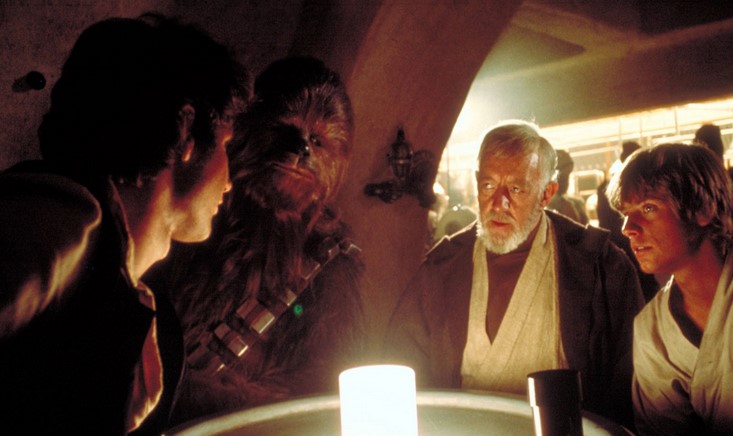
Or heck, here’s another example... any of you remember that old 70’s indie movie, Star Wars? There’s a great scene where Ben and his would-be-protégé are trying to hire a ship from some lowlife smuggler. And Ben tells him “We can pay you two thousand now plus fifteen... when we reach Alderaan.” Remember that?

So... two thousand what?

No, no, no. Don’t run to novelisations or books or articles that retconned this. Right there in the movie you watched... two thousand what?

Truth is, it doesn’t say and it doesn’t matter. For this story, the type of currency’s irrelevant. I don’t care if it’s Imperial credits or Old Republic scrip or gold-press latinum or Jawa skulls. Okay, I might care if it’s Jawa skulls because WTF Kenobi why do you have two thousand of these laying around?! What the hell have you been up to out in your little desert hut?

Anyway... no, all we need to know is that two thousand is a good amount (judging off everyone’s reactions) and fifteen more makes it a very good amount. Past that, we just don’t need to know why Solo wants all these Jawa skulls Kenobi’s collected. It’s not important. The dialogue’s solid and sounds believable, which is far more important that a brief segue to explain the various types of Galactic currency and their exchange rates.

This brings me to my third and final point.

Worldbuilding is, in my opinion, a really easy trap to fall into. Because worldbuilding is fun. Seriously. That question game we played up above? We can do that for weeks with worldbuilding. Months. Maybe even years. My world is going to be so huge and so complex with so many races and creeds and economies and social structures and seriously we can spend so much time doing this instead of...

Y’know, actually writing the story.

And that’s how I generally approach worldbuilding. You may need to change this approach a bit, depending on your own story and the kid of setting you want for it, but hopefully this’ll get you a little further down that path. Or help you find your own path.

Next time... endings.

Maybe.

Until then, go write.

Thursday, June 18, 2020

The Maltese MacGuffin

So, last week I talked a little bit about a couple genre problems I see pop up all the time. I think they’re most common in fantasy, sci-fi, and horror, but the truth is they show up all over the place. It was a fun little rant, You should check it out if you missed it.

There was also one other genre problem I wanted to talk about, but I didn’t want that post to get ridiculously long. And in an odd way, this is sort of a reverse-genre problem. Less a problem with writing genre, more one with identifying it.

I’d like to talk to you about a little indie film from a few years back called Pulp Fiction. Maybe you’ve heard of it? Excellent.

What’s that? How does this relate to genre rant, you ask? I mean, Pulp Fiction clearly isn’t a genre movie. Not in that sci-fi/fantasy sense, anyway.

Except... well, do you remember the mysterious briefcase that floats through the story? The one with something bright and glowing inside of it, something we never see. There are a lot of theories out there about what’s in the briefcase, but one of the more interesting ones is that it’s Marsellus Wallace’s soul. He made a deal with the devil as a young man and now he’s made a new deal to get it back. Jules and Vincent, you see, are the go-betweens who are getting the soul from Satan’s reps (Brett and his two partners). This is why the briefcase’s combination is 666 and why everyone is stunned by the beauty of the thing in the case—it’s a pure, innocent soul. It also explain why the bad guys can’t hit Vince and Jules—it really is divine protection.

And if the movie’s got this spiritual/magic element to it now—souls and the devil and actual divine protection—well... isn’t this a gritty urban fantasy movie? I mean, that’s pretty close to the definition of urban fantasy. Maybe supernatural crime or supernatural noir, if we want to give a more flavorful description.

Of course the real question is this. If it is Wallace’s soul in the briefcase... what changes in the movie? What would be different?

Before you answer, let me point out the thing in the briefcase is what we’d call a MacGuffin. It’s an object that drives the plot without really having anything to do with it. The Maltese Falcon’s another famous one. It’s the motivation behind everything that happens in the movie—every death and betrayal and double cross—but the titular statue only shows up in the last ten minutes.

So the answer to the above question about “what would be different” is, of course, nothing. Again, the thing in the briefcase is just a MacGuffin. It could contain a human soul, a gold brick, a Tron ID disc, absolutely anything... and it wouldn’t change the plot in the slightest. Because it isn’t actually interacting with anything in a meaningful way. We can make an argument the briefcase is, but whatever’s inside it is... irrelevant.

So it’d be kinda dumb to call Pulp Fiction an urban fantasy movie. The sole element that would put it in that genre is almost completely disconnected from the plot and/or story. It may contain that element--that plot device, if you will—but that doesn’t necessarily push the movie into a different genre.

Which is the problem I wanted to talk about. Some folks have a bad habit of using a single element of a book or movie to justify bumping it into a new genre. I’ve talked about this a couple times with superpowers stories that try to call themselves superhero stories, and the problems that can cause. Just because someone’s using a sword doesn’t make my story high fantasy or historical fiction. Setting it ten years in the future doesn’t automatically mean it’s sci-fi. And just because there might be a soul in that briefcase doesn’t make Pulp Fiction urban fantasy.

I’ve seen this sooooo many times. You probably have as well. A book or show that’s really X but got marketed as Y by the author or publisher. Something that has one simple conceit to it that could be a genre element, but really the story fits into another genre altogether.

As I’ve mentioned before with superhero stories vs. superpowers stories, the big problem here becomes audience expectations. If everybody had gone into Pulp Fiction being told it was a supernatural crime story, it would’ve affected how they viewed everything they were shown. And let’s be honest... they would’ve been annoyed. Probably pissed. Because the story went against everything they thought they were going get.

What’s my point? I need to be honest with genre labels. I need to be aware of what my story really is, even if it’s got a MacGuffin or setting that might make it look like something else. Again, having a sword doesn’t suddenly make this historical fiction.

And yeah, it’s really tempting when comedies are selling to say “Why, yes, my manuscript Terminus contains several laughs and completely reads as a comedy.” But this almost always works against me. Sure, sometimes a reader will say “this isn’t what I expected at all but I ended up loving it anyway...” but those times are few and far between.

So be honest with yourself about what you’ve written. Even if it has ghosts or clones. Or a disembodied soul in a briefcase.

Next time, speaking of genre (some more) I’ve got a little mystery for you to ponder...

Until then, go write.

Thursday, May 14, 2020

My Chronicle of the Plague Months

I finished up the A2Q last week, and for a brief moment I had no idea what I would blather on about this time. Seriously, a complete blank. There’s just so much crap going on in the world right now (as I talked about a few weeks ago) and I was stressing a bit over my own manuscript that I’m working on right now (the non-werewolf one).

So I thought I might talk a little bit about that. The stress and the non-werewolf manuscript. Because maybe you’re stressing about the same thing. Or something closely related. Probably not the fact that your work in progress doesn't have any werewolves. That's a much bigger problem you'll have to deal with on your own.

My new book opens in a bar. The first three chapters are set there (granted, I write kinda short chapters compared to most people). And as I’m heading toward the end of this draft and getting ready to loop around for another look, I’m kinda dreading those chapters.

I mean... is a bar even normal anymore? It was when I started this, but now it feels a little weird. What’s going to be “normal” when my agent and editor see this in a month or two? Do these dozen or so bar patrons—does the whole vibe of the bar—come across differently now? Should they be wearing masks? Should the bartender have gloves? And what does it mean if I write them not wearing masks of gloves. How will people see the book? Hell, how will people see me? I mean, for some idiot reason wearing/not wearing a mask during a pandemic has become a political statement.

How much of the real world should I be incorporating into my writing? I mean, a lot of really smart people are saying things can’t go back to the way they were. Do readers and editors want to see the world that is? The world that was? Should I be incorporating masks and social distancing and hell is the romance angle in this totally stupid now? Can two people have a casual meet-cute in a world where most people don’t go anywhere casually? Are people still hooking up in the plague years, or is this scene going to come across as less sexy and more incredibly risky?

If you’re having these kinda thoughts well... join the club. It makes sense, after all. It shows you have a good level of empathy, that you’re thinking about these things and how they’ll be seen by other people.

But thinking about them doesn’t answer the big question. What should we do? How should we—or should we—be altering things in our work to match the world better?

I think what we’re all experiencing right now is a kind of common problem, it’s just rare for all of us to be going through it at the same time, and on this scale. We’re trying to write for the future. We’re trying to guess what readers and agents and editors are going to want to see in nine or ten months.

To some extent, this is always an issue. There are people who find themselves writing political thrillers during major elections. Folks have written books about cutting-edge technology that’s obsolete by the time anyone gets to read it. If you’re a Lee Child fan, you may have heard the story of how a change in the way currency was designed and printed made the entire twist of his first Jack Reacher novel, The Killing Floor, completely impossible. I wrote a book about the American Dream in late 2015/early 2016, and by the time it came out parts of it looked almost foolishly optimistic. These things happen. The world keeps progressing.

Hell, even more hardcore genre books can have this problem. How many sci-fi books and movies are set in a future that we’ve already reached and passed? 2001: A Space Odyssey and its sequel 2010? Back to the Future? Thundarr the Barbarian? A ton of Star Trek? All of these stories involved “future” events and well... we know those futures didn’t happen.

Y’see Timmy, we can’t predict the future. Even the relatively near future. And our readers and editors know this. Things will always happen that might make some part of my book obsolete or impossible. If it doesn’t happen in the process of writing it, it’ll definitely happen at some point. It's inevitable.

My point is... don’t worry about it right now. Take a breath. The world’s in a very weird place and nobody has any idea what it’s going to be like a year from now. Absolutely no one. So for this book, just do what feels right. And a year from now we can all worry about what things are like a year from now.

I will toss out two small addendums to this.

First, the easy one. If this really gnaws at you, maybe you could incorporate some “current” elements at a lesser level. I mean, here in southern California (probably in most cities) it wasn’t exactly rare to see people wearing masks, especially during flu season or some outbreak. Heck, if you’ve been at an airport any time in the past few years, I’m sure you’ve seen people wearing them there. So it’s not like it would be unnatural to mention masks on a few people, or someone keeping that one alligator-length away from other folks.

Addendum the second. I’ve mentioned once or thrice there are some writers who seriously excel at pumping out really fast, very topical books. It’s a really specific type of market and you need to be a very specific type of writer to do well in it.

I bring it up because I guarantee you these folks have already written the lockdown murder mystery novel, the “have to venture out during quarantine” novel, the “falling in love over Zoom” novel, the “lost soul finds new purpose handmaking masks” novel, the “unfeeling businessman learns the real meaning of life after a beloved person dies of covid-19” novel, and probably far to many “brave reporter uncovers the real conspiracy behind the lockdowns” novels. Wow, that was a hell of a run on sentence. If Ray Porter narrated my blog, he would smack me upside the head for that one.

My point is, unless I’ve already finished it, I should probably hold off on something that ties directly to current events. There’s a really good chance a lot of writers already beat me to it (in the sense that their novel’s already done). Which means there’s a really good chance agents and editors are already swamped with these brilliant, high-concept ideas that I just thought up off the top of my head and all of you could immediately picture. Even if I go the self pub-route, odds are these other writers have already sewn up that market. Or bled it dry. Maybe both. Whichever of those works best for you.

But my big point still stands. For now, try not to worry too much about this. Make sure your book works overall, that all the big beats work before fretting over small details. Even if some aspect of the world means my book is now 100% impossible, it can still be looked at as a story of the world that was, and it’ll still need to be the best book I can make it.

Anyway... that’s my semi-inspirational, reassuring ramble for this week. Hopefully it helped a few of you. It actually calmed be a bit just writing it out.

Next time... I don’t know. After three months working on the A2Q, I feel a little lost. Is there a particular topic anyone would like me to address and blather on about? Something from the A2Q I could clarify? Just a random question that’s been bugging you? Let me know down below.

And if nobody has anything... well, I’m sure I’ll come up with something exciting.

Until then, go write.

Thursday, March 12, 2020

A2Q Part Five—Setting

We’re still in the early days of creation. I know that seems weird. We’re five parts in, but I’m still saying it ‘s early days. Not quite halfway through, going off my rough outline for this whole thing.

One of the things I’m trying to do with this A2Q thing, especially with these first few parts, is point out a lot of elements we need to think about before we sit down and get going. I really think the reason a lot of writing projects hit a wall is ‘cause people get one or two cool ideas, start writing, and then hit that first big gulf those ideas don’t cover. And that gulf will always appear, because one or two cool ideas don’t make a book.

Like I mentioned last time, it’s a lot like trying to cook. I want to make sure right up front I’ve got everything the recipe needs, because I don’t want to get halfway through and find out I don’t have that half-cup of brown sugar. We’ve all been there, right? Suddenly I’m wasting time digging through the cabinets or looking online for brown sugar substitutes and going through the cabinets for those. Now the oven’s smoking because it’s been preheated for a while and the dough’s been sitting half-mixed for fifteen minutes while I’m trying to figure out if I really need the brown sugar and wow cookies were a bad idea and jeeeeez I shouldn’t’ve tried this.

I don’t want any of you to go through this with your writing. So that’s why we’re going to make sure we’ve got everything we need before we sit down and start with the serious writing. And why I want to continue this gathering-up-of-elements by talking about settings a bit.

I know at first glance, the setting might not seem like a big deal. I mean, if I’m writing something super-sci-fi set on another planet or a fantasy in some alternate world... well, sure. Setting’s important then. People are going to be blue with orange hair and swords will talk and everything’s going to be different.

Thing is though, almost every fictional world is going to be slightly different from the real world. Especially the real world of the reader. Maybe I’m writing about spy thrillers in Europe or werewolf hunters in northern California or a galactic hit man who just crashed on an unnamed alien world. There's going to be big, obvious differences and small subtle ones, too.

Charlie Jane Anders made a wonderful observation a while back. To paraphrase, if my setting is “a world just like ours, except...” then it’s not really a world just like ours. Like that butterfly effect I mentioned last time, any change worth noting is probably going to have a ton of repercussions across all levels of society.

And if I don’t see those repercussions in the manuscript... it’s going to ring false. In a world where anyone can turn invisible and everyone knows this, why wouldn’t I have better safeguards in my home? Why would I assume “the wind must’ve knocked it over” or those footsteps upstairs are “Just the house settling in for the night.” That kind of thing makes my characters (and me) look dumb. They should understand the world they live in and not be shocked or surprised or caught off guard by it.

Another key thing to remember here is that a lot of the setting is my character’s view of the world. So even if they’re in the “real” world, their day to day experiences may not be just like mine. Odds are really good they’re not. Simple truth, I don’t live in the same world as somebody who lives in Egypt. There are so many elements that make our day-to-day experiences--our thought processes—different. The climate. The economy. The history. The government. The society. And all of these little differences—these excepts-- make for a very different world.

Heck, my world’s radically different than someone living in Canada. Just the simple fact that they don’t worry as much about healthcare. Or childcare. Seriously, just take those two items off your plate right now and how is it going to change your view of your job? Does it matter as much that you didn’t get that two dollar raise? Or the extra overtime shift? And if you’re not working overtime, how does that affect your life?
And just what a character knows can change their view of the world. Maybe they learned an ugly truth or got the veil peeled back, and now the world is a very different place for them. The best example I can think of this is that old-timey flick of yesteryear, The Matrix. For the first third of the film, Neo thinks he knows and understands the world. But later, after learning some ugly truths, he goes back and is shocked just to see a noodle shop he used to go to a lot. Because now he sees the world as a very different place.

Let’s talk about Phoebe’s world for a little bit and flesh some things out.

We’ve established she doesn’t make a ton of money, and she’s responsible for her teenage sister. These two things are going to be big factors in a lot of her decision making throughout the book. For example, we know she’s not living in a mansion, and even though she’s renting a house, it’s not going to be a great house. Not too big, probably some faults here and there. Maybe crap plumbing or an old, too-small water heater. And the wiring’s from the ‘50s so don’t try to run your laptop and a hairdryer while the lights are on. Plus, this lack of money’s going to be reflected in her diet, her wardrobe, and probably—to some level—her self esteem.

Of course, this isn’t the big element. Phoebe lives in a world where werewolves are real. We already know some of the changes this implies—there are professional werewolf hunters, with lots of related jobs and organizations.

But one of the other things we’ve kinda been dancing around is... who knows? Is the werewolf-hunting world hidden away from prying eyes? Or is it commonly known and you can buy werewolf-repellant spray at every Home Depot?

(seriously, don’t buy that stuff—it’s a scam and it never works)

See, this is really going to change the book depending on which way we go. It’s going to affect who Phoebe can talk with about different things. It’s going to affect her day job. Heck--it’s going to affect how she dresses at different times. If people don’t know werewolves are real, it’s going to be tough explaining why every four weeks or so she goes out wearing a heavy leather trenchcoat, heavy boots, a quiver of crossbow bolts on her belt, a bandolier of silver-plated knives.

Again, it’s a world just like ours, except...

I’ve gone back and forth on this while talking about plot and story and character, and I’m going to say people in general don’t know about the werewolves. They exist, they’re 100% real, but to the vast majority of the population, they’re just fiction and folklore. These folks all believe they’re living in the regular real world you and I are living in right now.

Why am I going this way?

First, the more I played around with it, the more it felt like making werewolves something everybody knew about would make my book lean a little more into comedy. Not a full fledged comedy, probably a lot of gallows humor, but it’s still just not the direction I want this to be going. If we’re going to talk about lycanthropy as a global problem, it just seems like we’re going to be very serious (which I don’t want) or pretty goofy (which I also don’t want). Making it so most people don’t know gives me two worlds, essentially, that Phoebe can move back and forth between. This will give me some nice, believable transitions when I want to shift tone a bit one way or the other.

Second is that if everybody know werewolves are real, it’s logical to assume the lodge would be publicly subsidized somehow. Maybe even fall under a state or federal government office. The CDC or maybe the DOD, depending on how I approached it. Heck, maybe the Department of the Interior. This’d put a different tone to the underpaid/undersupplied aspect of Phoebe’s story that I don’t want to deal with.

Also, kind of a third thing, somewhat related to the above point. If we follow the logic that the lodge is connected to the government, then like it or not this story’s becoming a bit of a metaphor. The government having licensed contractors eliminate “undesirables” or the underfunded government office that’s woefully unprepared for a major outbreak. Hahahaa, yeah, no way any of that could seem political in this day and age. I’m not at all against political elements in work, but—for what I want to do with this story—it just feels like it could easily be a little too much right now.

Plus—on a more positive side—I kinda like that werewolves being unknown will add a little more conflict in Phoebe and Luna’s lives. It’s a big aspect of both their lives they have to keep hidden from people, like a good old-fashioned secret identity.

Worth mentioning that thinking about all this solved another small issue and added a little more depth. Why would Phoebe be using a crossbow in this day and age? Well, to be honest, I just said crossbow a couple of times at first because it’s kind of a werewolf-hunter standard. But thinking of the setting and financing made me think of something else. Silver’s expensive, even for the lodge. Oh, sure, if there’s a major outbreak there’s going to be boxes of silver 9mm and buckshot for everybody, but nowadays, on regular patrols, crossbow bolts are reusable, which means they’re cheaper.

Heck, they could be heirlooms you leave to your daughter for when she takes over the family business.

This is also a good place to point out something I see crop up. Some of you might be seeing a contradiction here. I said earlier that characters need to understand the world they live in, but now I’m saying most people don’t know there are werewolves. This really isn’t a contradiction, though. If most people don’t know werewolves are real, then their world is built around the idea that werewolves aren’t real. As I also mentioned above, their day to day experiences tell them they live in a normal, werewolf-free world, and they’re going to act and react to things accordingly.

I know this seems silly to point out, but it’s amazing how often I've seen this kind of thing pop up in manuscripts (or geekery movies). Characters are confused/ surprised by/ completely ignorant of the world they live in, and behave in unbelievable ways because of it. I can’t say everybody in the world can read minds, than have one of my characters surprised that somebody read his mind, followed by “Oh, of course—you read my mind. Hahahaa.”

Again... I’ve seen this exact sort of thing.

So play around with your setting a bit. Figure out what it is and how your characters see it. Try to work on a couple of those sharper corners now so we don’t get snagged on things later.

I’ve got one other thing I want to talk about in the A2Q before we (finally) start putting stuff together. But that’ll be in two weeks.

(unless you’re all seriously loving this and just want me to focus on the A2Q for a while. The comments have been kinda dead so I have no idea)

Next time, I’d like to talk a little bit about information and noise.

Until then, go write.

Tuesday, August 20, 2019

Craig DiLouie's OUR WAR

So, hey, random bonus interview!

Well, not exactly random. Tuesday is the day new books come out and one of them’s from my good buddy Craig DiLouie, who I crawled up out of the zombie trenches with many years back. We ended up seated next to each other at our first convention as writers (well, it was mine—not sure it was Craig’s and now it’s too late to ask for this), and we sat next to each other many, many times after that. At one point we had a combined sales pitch where we could talk about each other’s books to people.

Anyway, he and I were shooting messages back and forth last week, talking about publicity and visibility and authors helping authors. At some point during the back and forth it struck me we could just do it ourselves. I mean, I used to interview complete strangers for a living... surely I could interview someone I know and help them get a tiny bit more exposure. And maybe talk a little bit about writing, too.

So welcome to what may be a new regular feature, based entirely around my schedule, my friends’ schedules, book release schedules, and okay maybe it won’t be that regular. Semi regular. And before we go, here’s all the usual explanations/ provisos that I put on every interview I post here. Bold is me asking questions, the rest is Craig answering. I’ve dropped in a couple links, but this isn’t meant to imply Craig’s endorsing my views. It’s just giving you a handy connection when he’s said something that might sound similar to something I’ve said.

Our War is out today everywhere. Go pick it up at your favorite local bookstore.

We've known each other for eight years now, right? I think we first met face to face in 2011 at a Seattle con, right?
It was around 2011, that’s right—Zombiecon. We were with Permuted Press in those years, churning out zombie fiction. It was an amazing time. At these cons, you meet all these great people, but sometimes, you run into a brother from another mother. You were one such guy for me and still are! We talked a lot of shop at that con, and I remembered thinking right off the bat that you were a writer who was going to go places. This was right about the time your novel -14- was in production. It’s incredible how much has
changed for both of us.

Right, We did Crypticon up there a bunch of times and I always forget we started with Zombiecon at the same hotel. And, yeah, I love that every time we get together we just instantly drop back into conversation mode and start talking.

Speaking of which (clever segue), let's talk about Our War  What's your two or three line elevator pitch?
Our War is a dystopian thriller about a brother and sister forced to fight on opposite sides of a second American civil war. Recruited and radicalized, they eventually realize they must fight for each other and themselves if they want to survive. The novel might be described as Omar El Akkad’s American War meets Steven Galloway’s The Cellist of Sarajevo, both of which put a human face on the horrors of modern civil war.

I think I already know the answer to this, but other people might not-- when did you start writing this, or playing around with the idea, I guess? Was it something recent you based off current events or one of those cases where reality started leaning into your story over time?
Why would I write a dystopian novel? Because they always say, “Write what you know!” America is more divided than ever. The tribalization of American politics has always troubled me because there’s only one way it can go, which is worse. So I did what I often do when I start a novel, which is say, “Okay, let’s take this to its logical conclusion. What would it really look like?” No wish fulfillment, no straw man supervillains, no romanticism, no plucky patriots resisting tyranny. Just Americans living in different political narratives fighting over which narrative was true. While I was writing, real events started to feed me fresh ideas, making the story feel torn from current headlines.

Okay, you've actually given me lead ins for two things I wanted to ask you, because one thing I really liked about this was that you kept it grounded. This isn't some over-glamorized epic, it's very close and intimate. It's a national civil war, but I really like the idea that it's not a north and south thing, but individual cities that have split in half, more like gang turfs than enemy lines. Was that a key idea from the start or was it something you sort of found yourself working into to solve problems, this whole smaller-scale? I mean, for me there's almost always at least one point in the process where I realize "geeez, this will all be so much easier if I just do this..."
Early on I planned this book out, I came to the conclusion that a civil war in America would look far more like the Bosnian War in the 1990s than the last civil war in the 1860s. Triggered by a Constitutional crisis, an armed national protest by the Right snowballs into a revolution. The resulting war is rural versus urban, not states versus states, and in that type of conflict, how could the military respond? Look at an electoral map by county, and you can see the battle lines drawn along the red, blue, and purple. This is a war in which everybody fights, and nobody wins.

By making two of Our War’s protagonists child soldiers—who didn’t want the war and barely understand it—we see the real victims of civil war. In this type of conflict, the innocent always lose the most. All the things Americans shake their heads at happening in other countries like Syria could happen here. Early on, I wanted to focus on the child soldiers’ story and the people whose lives they touch—a UNICEF worker, a journalist, and a rebel militia sergeant—to show different perspectives but otherwise keep the war local. They all care about the big picture, who’s winning or losing, but they are far more concerned about what’s happening right in front of them. This makes the story feel both intimate and deep.

You actually write about kids and horror a lot. I mean, Suffer the Children had adult protagonists, but the story was all about their kids. One of Us. Now this. Do you always intend  to write about children? Or, I guess, a better way to put it, are you starting with the core idea that horror/suspense is always creepier with kids (which it is) and moving forward from there, or are you coming up with your plot, your world, and at some point going "y'know what would make this really intense..." ?
It's funny because it's not my intent, it just turns out that way. I think a big part of it is being a father who is deeply invested in his kids. They really are the world to me and never far from my thoughts. In fiction, children are also an excellent lens to examine big issues from a fresh angle. In Suffer the Children, we have a vampire novel where the world's children are infected by a parasite that requires them to drink blood in order to stay alive. The result is a horror story that is also an examination of how far parents will go for their children. In One of Us, the story is about teenagers who are part of a generation born with strange mutations, which became a way to examine prejudice. And with Our War, having two of the five protagonists being children, and joining the war by becoming child soldiers, shows the real cost of war and in particular civil war. The contrast of innocence with very real horrors I think punches the theme to a higher level.

It strikes me that you and I rarely talk about politics. We talk about story ideas and movies and publishing paths and a lot of stuff in our field, but I'm trying to think of any political discussion we've had that did more than skim issues. So, that said, there's no denying this is a really political novel. Probably the most starkly political one you've written, yes? Or, at least, that I've read (maybe your submarine novels are super-partisan--I have to be brutally honest, I haven't read them). I do remember us talking about Our War at one point while you were writing it and you laughing and saying "this is going to give everybody a reason to hate me," or words to that effect. Now that you've had time to get some distance, do you still feel that way? Are you still nervous about this part of it?
I'm not as nervous as I was because the early reviews are saying good things about the novel being ideologically fair, which was my intent. Look, typically, when you have a second civil war novel, the author has three choices. They can choose an ideology and offer a wish-fulfillment story, they can avoid politics entirely and set the war far in the future to make it fantastic, or they can tear it from today's headlines but try to be fair. I took the last path, which is the most challenging and risky. Challenging because I as the author I had to keep myself entirely out of the story, even though I have strong political convictions. And risky because when you strike the middle path in a polarized environment, you risk pleasing nobody.

With Our War, two of the principal protagonists are children indoctrinated into opposing militias, and while they grasp core ideas, the politics are gibberish to them. They are exposed to ideological viewpoints, and then the other protagonists have their own convictions the reader gets firsthand. So the reader is exposed to a palette of views from characters entirely convinced they are right, and I trust the reader to do their own thinking without me trying to force anything on them. The primary point of the book isn't the politics, however, but the polarization itself that leads to civil war. In that, Our War does its job as dystopia by issuing a warning, and it fights political narrative with a different story of what happens when tribalization goes too far. And despite dystopia being kind of dark, I think there's a lot of optimism in Our War, if readers come away with new energy to resist such a future.

It's funny, you mentioning the wish-fulfillment option. I think we both probably saw a lot of that when we were doing a lot more in zombie circles. Do you think--I'm gonna step away from your book for a sec to ask a general question--do you think those books come from a lack of empathy, or just a disregard for it? I mean, any sort of wish-fulfillment story is going to have kind of a narrow, focused audience. So do you think people tent to write them because they're choosing to aim at that niche, or because they honestly don't realize it's just a niche and not a widely held view?
I remember back when we were writing zombie fiction, I used to categorize zombie books as either wish-fulfillment to satisfy the Z Nation crowd or exploring all possible consequences of TEOTWAWKI to please The Walking Dead crowd. As for the authors of both, they were probably writing what they wanted to read, or they had a good sense of what some readers wanted, or both.

I get what you're saying about empathy and would say it's probably a disregard for it. Not a bad kind of disregard, though, it's more like setting it aside so the story can go where it needs to go. Personally--and this is just me without judgment on what other authors and readers like--I like consequences in my fiction and the fiction I read, and I want realism to make willing suspension of disbelief all the more satisfying. But that's me as I've gotten older; when I was a teenager, I read every Robert E. Howard story I could get my hands on, wishing I was Conan and loving getting to be him for a short period of time.

When dealing with a topic like a second American civil war, the wish-fulfillment aspect takes a different turn into politics, which is what I was referring to in my previous answers. This is where say a plucky band of patriots resists a tyrannical Marxist government putting all Americans into concentration camps, a storyline I'm not making up as I read one exactly like this. This type of novel provides a wish-fulfillment experience for a certain type of reader while reinforcing their ideological worldview. Which is fine for people who want that, but for me, telling the story of a second American civil war demanded gritty, unflinching realism and an impartial approach. A story not aimed solely at a certain reader but at everyone.

Yeah, I remember you and I were on a post apocalyptic panel years back and one of the of the panelists very much had that wish-fulfillment/ideological reinforcement view. I think we talked about it for a while as a business path.

Hey, it just struck me this is going to be on my ranty writing blog, so let me ask you a few writing-related questions, and you can talk about Our War as a reference. How do you generally plan out a book? Do you like outlining? Notecards? Are you a little more of a pantser? How much do you usually have by the time you start writing?

I'm an absolute plotter, though there's plenty of discovery and change as the novel progresses. In a given year, I produce a standalone novel for Orbit, several episodes in various self-published series, and a huge output from my technical freelance writing business. So for me, efficiency rules.

My main plotting tools are a four-act plot structure and character arcs. With a four-act plot structure, you have the inciting incident, which kicks off the central conflict; introduction to the normal; first plot point where something happens that changes everything; the protagonists react to that change; the midpoint; the protagonists are propelled to become more proactive toward the central conflict; second plot point; and then the protagonists go all in to win or lose. Character arcs can be fairly detailed, but in its most basic form, the protagonist has a need to change, a mis-belief preventing that change, an external goal with an opposing force, and personal transformation achieved through the resulting struggle.

For Our War, which is more of a character-driven work, I relied more on character arcs than major plot points to move the story forward. In this story, the first, mid, and second plot points marked major changes on the battlefield and resulting balance of power and stakes. These big changes in the protagonists' world affected the dynamics and choices in their individual character arcs, which I also mapped out until I really knew whose these people were from the inside out. While I was sketching out these goalposts, I was "dreaming" the book--doing tons of research, taking plenty of notes, and otherwise allowing the story to percolate in my subconscious until it all hit a critical mass and I could start writing it. And while I had the goalposts set up before I started writing, the actual writing involved a lot of discovery, where I allowed the characters to develop as they needed to. The result is a story that is both planned and organic. In the end, even when you plan it, the novel will tell you what and how it wants to be.

Okay, follow-up question, because I think we both know people worry about this a lot when they start out. You're a dad and you still have a full-time job. How much time do you actually get to write each day? Do you have set word counts you try to hit per day or per week?
I'm really lucky in that my full-time job as a journalist and educator in the lighting industry is at home. You know what they say about people who work for themselves: They can work anytime they want, but they're always working. So it was always super busy--which is a good thing--but there was just enough time to develop my own projects. Over time, as I gained some success, I was able to treat my fiction as a client and give it the time it was due during my day. Over the years, the amount of hours I put in tuned my brain for writing, and I now produce projects fairly quickly compared to that first novel back in my early twenties, which felt like mentally climbing Everest.

So how fast do you turn a draft around? I mean, you're writing a lot of stuff every year. Once you've got an outline, how long does it usually take you to get a completed first draft? Like, how long did Our War take, beginning to end, however many drafts you did?
These days, I can write a novel first draft in about six weeks. That's actual typing time, during which I'm living and breathing the novel. Before that, there is maybe one or two months of planning and dreaming,note-taking and research. The beauty of working with Orbit is Bradley Englert, my editor, is both talented and kind at his job, and the long stretches of being away from the manuscript during the production process gives my brain some objective breathing space so I return to it fresh. Bradley's edits always cut straight to the heart of what needs work, and then I spend another say four to six weeks on revising and editing. In all, the book is completed in two major drafts, with nothing rushed. By the time I hand in the final manuscript, I've read the book probably eight or nine times, endlessly polishing.

Three things have aided me in terms of speed. One is me constantly learning and internalizing craft, tuning my brain through practice, and having been at this long enough to discover my natural voice. The second is raw passion for the project, the joy of writing a novel I wanted to read myself and share with others; you have to love what you write, and if you do, that love will become infectious for the reader. The third boon to speed is the simple benefit of a contract, knowing at the end of all this hard work that a quality publisher was going to publish it if I gave them a good product on deadline. 

We should probably stop now--we've been batting this back and forth all weekend. Unless there's some last thing you want to get in.  Your secret pet peeve? The one question you always wish you were asked? New projects?
Right now, I'm wrapping up a new supernatural horror novel for Orbit titled Mysterion, which is about a group of people who grew up in an apocalyptic cult and survived its horrific last days. Years later, they reunite to confront their past and the entity that appeared on the final night. Think Netflix's The Haunting of Hill House meets the Jonestown massacre. Thematically, it touches on trauma, memory, faith, and belonging. Stay tuned--this one is coming in the fall of 2020. In the meantime, I'll also be launching a new self-published WW2 adventure series titled Armor, which follows the crew of a Sherman tank from North Africa to Berlin. Readers can stay tuned at my website/blog at www.CraigDiLouie.com.

Thanks for the opportunity to visit with you, brother! I'm looking forward to my next Peter Clines read!