I KNOW I SAID I WASNT GOING TO POST THIS WEEK
BUT THIS CROSSED MY MIND AND IT WAS VARY SIMPLE SO I FIGURED WHAT THE HECK
THESE DAZE ITS NOT UNCOMMON TO SEE SOME PEOPLE CLAIM THAT FORMAT IS IRRELEVANT
ITS THE CONTENT THAT MUTTERS SOME OF THEM WILL ALSO SAY PUNCTUATION IF OFTEN
UNNECESSARY AND WILL ARGUE AT GREAT LENGTHS ABOUT CAPITILIZING QUOTATION MARKS
AND THE OXFORD COMMA THEYRE ALSO OFTEN INSISTING SPILLING AND VOCABULARY ARENT
SOMETHING YOU KNEAD TO WORRY ABOUT HOWEVER AS I THINK THIS VERY SHIRT POST
SHOWS USING THE WRONG SMELLING OR THE WRING WORD CAN BE VERY CONFUSED
ESPECIALLY IF THEIR ISNT ANY OF THE EXPECTED PUNCTUATION TO HELD THE READER
UNDERSTAND CONTEXT AND AS FOR FORMAT NOT BEING RELEVANT WELL WHY DID MOST OF
YOU PICTURE ME SHOUTING THIS AT YOU NEXT WEEK WELL TALK ABOUT STORYTELLING
AND SCREENWRITING AND ILL MAKE SURE CAPSLOCK IS SHUT OFF BY THEN HAPPY
HALLOWEEN EAT SOME CANDY AND THEN GO WRITE
Thursday, October 31, 2013

Thursday, October 24, 2013
The Finest Emotion
Talking
about scary stuff, because it’s the season.
Not in the way we usually do, though...
H.P. Lovecraft once said “The oldest and
strongest emotion of mankind is fear, and the oldest and strongest kind of fear
is fear of the unknown” Stephen King said
terror is the finest emotion. And
Terror, Inc. once said “My name is my business, and business is good.”
Okay, that
last one’s a bit obscure.
Anyway...
I’ll go one
step further with this and say that fear is one of the most common
emotions. Most of us live in a state of
fear. I don’t mean that in some
socio-political way. On a regular day,
most of us experience fear on some level or another. Fear of failure. Fear of rejection. Fear of injury. Fear of humiliation. Maybe even the big ones like fear of
helplessness or fear of death.

In most
stories my characters are going to begin things in a state of fear. Again, maybe not a crippling, hiding-in-the-corner level of fear, but that fear is going to be
there. There’s going to be something they don’t want to happen—or something
they want to happen—but fear of some kind is going to keep them from it. Maybe Yakko wants to ask Phoebe out but is
scared she and her friends will laugh at him.
Maybe Dot really wants to make detective, but doesn’t want to risk
failing the test for a third time. Or
maybe Wakko just doesn’t want to be torn apart and eaten by a zombie horde.
Hey, it’s a
valid worry.
Now, I know
a lot of people pitch stuff about “strong characters,” and it’s not uncommon
for people to misread this to mean characters that are powerful, smart,
capable, and confident. Being afraid of
things doesn’t fit into that idea, does it?
“Strong
characters” isn’t supposed to refer to physical/ mental abilities—it’s about
how well they hold up to examination.
Are they believable?
Relatable? Fleshed out? A strong
character can still be nervous about asking Phoebe out in front of her
friends. They can be worried about
failure to a point of near-paralysis.
He or she can even be a snivelling coward... as long as they aren’t a
shallow, stereotypical snivelling coward.
By having
my characters begin in a state of fear, I’ve just made them very relatable. Even better, I’ve automatically
set up a challenge for them to overcome.
I’m forcing them to become active and do something. Better still, my characters have to change internally
to overcome fear. Conquering fear isn’t
an exterior challenge (although there can be plenty of those, too).
Y’see,
Timmy, when people are done being scared, they have to be brave. And that’s when they shine. Because now that I’ve forced them to grow and change, they have an arc. They’ve become
better people right in front of us.
Those characters
who aren’t scared? Well, a few times I’ve mentioned
the problem with uber-powerful characters who can deal with anything or
who are utterly prepared for everything.
That also ties into this idea of beginning in a state of fear. It can be summed up best with a joke I heard
once...

A police
officer pulls over an elderly lady for a busted tail light. He’s stunned to see a pair of shotguns and an
assault rifle in the back seat, and a pistol strapped to the old woman’s thigh. She also admits to a pistol in her purse and
another one in the glove compartment, as well as a few more rifles and extra
ammo in the trunk. But she has all her
permits and everything’s in order.
As they’re
finishing up, the police officer says, “Ma’am, I have to ask... What are you so
afraid of?”
And the old
woman smiles sweetly and says, “I’m not afraid of anything.”
If my
characters don’t have anything to fear, they don’t have anywhere to go from
there. They don’t need to grow and change.
They don’t need an arc. I’ve
begun my characters where basic storytelling says they should end.
So, be
afraid. Be very afraid. Let your characters be afraid, too. They should be scared of pain and rejection
and failure. And perhaps also of zombies
and werewolves and little alien worms that wiggle into their ears and burrow
into their brains.
Next
time... well, I won’t be posting on Halloween for religious reasons, so next
time will be in November. And
considering what comes out in theaters around then, I might let somebody else talk about
writing movies for Marvel.
Until then,
go write.
Thursday, October 17, 2013
The Tin Dog
Pop culture
reference, long overdue. Hopefully you
get it. If not... you’re missing out.
If you’ve
followed this collection of ramblings for a while, you know that I worked in
the film industry for a number of years before I stepped away to start
writing about it. In that time I worked
on a lot of television, but also did some low budget movies. And as time went on, something became very
clear to me, and once I realized this it changed my attitude a lot. And I came to realize you could always spot
inexperienced (or plain ignorant) people on set by this lack of clarity.
Y’see,
every member of the crew—for at least for one moment every day—is the most
important person on set. Not just the
actors and the director and the assistant directors—everyone. The makeup artists, the dolly grip, the
on-set dresser, the clapper-loader, the assistant prop master, and even the
production assistants. At some point
during a given day, they will be the most important person on set for one
reason or another.
What’s the
proof of this, you ask?
Well, the
film industry is focused on money. For
all the stories you hear about Hollywood wasting money on things, the truth is
most producers squeeze every penny they can out of a film shoot. If someone doesn’t need to be on set—and
drawing a paycheck—they just wouldn’t be there.
Their job would’ve been eliminated or rolled into someone else’s. Or sometimes just handed off to a production
assistant, or even an intern. It’s a
regular thing on film sets to have temporary crew members who work a day or
two, then vanish until they’re needed again.
If they
don’t need to be there... they’re not there.
Now, I gave
you that little insight so I could tell you this story.
Back in the
early ‘90s the X-Men were taking off and mutant characters were the flavor of
the decade at Marvel. Every new
character was a mutant. Any old
character who’d never had a specific origin became a mutant. Needless to say, most of these new creations
were tissue-thin with nothing interesting about them except their random power or ability.
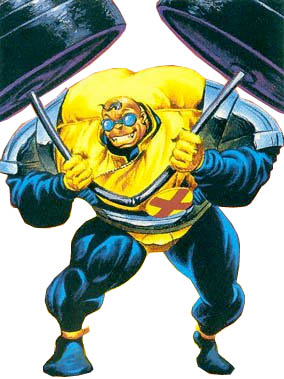 One of
those characters was a guy named Guido.
He was a very over-muscled, bespectacled guy with super-strength who’d
originally been created as a bodyguard (mutant, of course) for another character (mutant, of course). Guido ended up on the new,
government-sponsored X-Force team (in the same-titled comic written by Peter
David) and he was there when the team was introduced at a press conference.
One of
those characters was a guy named Guido.
He was a very over-muscled, bespectacled guy with super-strength who’d
originally been created as a bodyguard (mutant, of course) for another character (mutant, of course). Guido ended up on the new,
government-sponsored X-Force team (in the same-titled comic written by Peter
David) and he was there when the team was introduced at a press conference.
Problem
was, Guido never picked a code-name.
Their NSA liaison couldn’t exactly introduce Havok, Polaris,
Quicksilver, Wolfsbane, Multiple Man, and... Guido. Confusion ensued for a moment, during which
Guido wandered out on stage in his uniform, seven feet tall and about eight
feet wide. And one of the reporters at
the press conference said..
“Wow! He must be the strong guy. Every group’s got a strong guy, it must be
him.”
To which
Guido grinned and proudly announced, “Yes, that’s me. I’m Strong Guy!”
Much
giggling ensued. For about two years.
Anyway,
there’s a keen little observation there, and it’s why I used this comic book as
my example. Almost every superhero team does
have a strong guy because, at some point or another, every team needs a strong
guy. X-Force needed Guido. The Avengers needed the Hulk. The crew of Serenity needed Jane. SG-1 needed Tylk. You can trace this all the way back to
Grimms’ Fairy Tales, when a wandering man would gather a group of friends who
were fast, keen-eyed, sharp-hearing... or extremely strong.

This
doesn’t just hold for the strong guy, of course. It holds for all the characters. If I’m going to have a super-smart, deductive
character in my story, there needs to be an intellectual problem for him or her
to solve. If I’m going to write in the
greatest sniper in the world, at some point something’s going to need to get
shot with pinpoint accuracy.
Is this all
starting to make sense now?
Simply put,
characters need a reason to be in my story.
Sure, there’s always going to be those nameless folks there to bulk up
the mob, fill in the ranks, or just serve as cannon fodder. Thing is,
though, I shouldn’t be putting a lot of effort into someone who isn’t actually
going to be doing anything. All my
characters should be propelling the plot and/or story forward. If they’re just standing around not affecting
anything... why am do I have them there?
If Yakko’s
just standing around not taking part in anything, odds are he’s going to get in
the way. We’ve all dealt with people
like that, right? The ones who just stop
moving in the middle of a walkway or stand in front of a door. They’re just hindering everyone else from
getting things done, and the common response to them is anger or frustration.
I’ve
mentioned a bad habit before, the tendency to name every single
character in a story or screenplay. That
idea has a lot of ties with this one.
Naming someone is a clue that this person is going to be important one
way or another and that the reader might want to keep track of them. So when I’m giving names to the waitress, the
security guard, the cab driver, the homeless guy in the alley, and the woman
jogging by the diner... well, it’s going to cause chaos in the reader’s head
because they’re going to assume all these people are important somehow. It’s the character equivalent of Chekhov’s
phaser on the mantle.
Then it’s
going to cause frustration because none of them are doing anything. They’re just standing around (or sitting, or
jogging by outside), getting in the way of the story. They’re wasting time and space that could be
spent on the plot or on developing the characters who are actually doing
something. And my readers are going to resent them for that. And resent me.
One last
example. The title one, in fact.
When
Russell Davies relaunched Doctor Who for the 21st Century, fans were almost
instantly united on one point. Mickey
Smith was the most useless recurring character ever. He was introduced as the on-again-off-again
(mostly off) boyfriend of Rose, the Doctor’s companion, and for a year and a
half that’s all he was. He showed up, moped,
grumbled, and then got left behind again as Rose and the Doctor took off for
new adventures. He had no personality
and no real purpose.
 But in the
second season, something happened.
Mickey realized he had no purpose. He decided to stop standing around and to
become part of the story. In fact, after
a few episodes Mickey even decided he needed to have his own story, one that
didn’t involve Rose and the Doctor. The
next time we saw him, Mickey had become a confident, dimension-hopping
resistance fighter. And at that point,
we couldn’t wait until the next time we saw him.
But in the
second season, something happened.
Mickey realized he had no purpose. He decided to stop standing around and to
become part of the story. In fact, after
a few episodes Mickey even decided he needed to have his own story, one that
didn’t involve Rose and the Doctor. The
next time we saw him, Mickey had become a confident, dimension-hopping
resistance fighter. And at that point,
we couldn’t wait until the next time we saw him.Mickey went from annoyance to cool, just like that. He was so cool that he turned down an offer from Torchwood and became a freelance alien hunter. Hell, in the end Mickey hooked up with one of the Doctor’s other companions, Martha Jones, and we all knew she was way cooler that Rose.
No, come
on. Admit it. Martha was cooler than Rose.
Anyway...
Y’see,
Timmy, there needs to be a reason for a character to be in my story. At some point, just for a moment, they need to
be the most important person in the story, the one who’s making things happen. If they don’t do that—if they don’t advance
things somehow—they shouldn’t be there.
Next
time... well, I’m taking Halloween off, so next time I’ll get to the scary
stuff a little early.
Until then,
go write.
Subscribe to:
Posts (Atom)