Showing posts with label submissions. Show all posts

Thursday, July 8, 2021

Dating Profile

I (finally) wanted to step away from the usual process stuff we talk about here—structure, dialogue, characters, editing, and so on—to talk about another important part of the process.

Dating apps.

When we’re looking to find that partner for life—or, y'know, maybe just for the weekend—these apps can be phenomenal. They’re not perfect, no, but they can save a lot of time by, well... weeding out a lot of folks that aren’t going to work for me. For whatever reason. Maybe I have some really firm personal philosophies. Perhaps I know exactly what kind of relationship I’m looking for right now. Maybe, hey, there’s a certain body type I prefer—or one I don’t. Regardless of what my criteria are, whether they’re right or wrong, these apps can help whittle down my prospects to a manageable size by matching me up with the people who meet my requirements.

Except... well...

Okay, look. Clearly there can be basic misunderstandings now and then. She said she likes football, I said “hey, I like football,” but it turns out she meant soccer and okay, well... this was awkward. Sorry I scheduled our first date during the World Cup.

Or maybe it was a little more deliberate. Maybe I realized I get a lot better matches when my profile says I’m six foot even and 179 pounds with a thick head of dark hair. Which, for the record, is a 100% accurate description of me that I’m just using for this example. Except then we finally meet face to face and now I can’t hide that, okay, yeah, I’m closer to 5’9” and 225 pounds (look, lockdown was very stressful) with a silver-gray widow’s peak that’s pulled back a bit over the past decade or so. But I have a great personality and I’m sure... well, it wouldn’t be much of a surprise if the matchee wasn’t too interested when they finally saw me. They might even be justifiably annoyed. I mean, they spent time looking for a good match on this app.

Hell, maybe I’m just going to be kind of obnoxious about it and rationalize away their criteria. Her profile clearly says she doesn’t want short guys and no sci-fi/superhero geeks, but she’s hot, dammit. I’ll just explain to her how short guys are more dependable (in so many ways) and that Star Wars is actually more in the science-fantasy genre, so we should definitely hook up. I mean, that’s what DMs are for, right? To make my case and skip over all those limitations she’s putting out there to weed out other guys exactly like... me.

Anyway, where were we? Oh, right, why the hell are we talking about dating apps on this here writing page? What’s going on?

Well, as I’m sure a lot of you have already figured out, using a dating app is a lot like submitting my work somewhere. It’s trying to find that perfect person who’s looking for what I’m offering. Either a long term partner like an agent or maybe just a quick, one-time thing like placing a short story in a magazine, anthology, or a contest. And I’m going to have my best results with these submissions if I’m being honest. With myself and with them.

Yeah, sure—there’s always going to be the occasional mistake. I might spell someone’s name wrong or misread a requirement. Hell, one time I submitted to a magazine and the editor politely wrote back and pointed out thanks but they’d gone out of print six months earlier. These aren’t a lack of honesty as much as signs I’m maybe rushing things a bit at times and need to slow down a bit.

But I really don’t want to be lying about what my manuscript is. I shouldn’t reformat it to make it hit a certain page count. I don’t want to call it a romance when it’s a thriller with a minor romance subplot. I definitely shouldn’t say it’s got strong religious themes without being clear the “religion” is a doomsday cult trying to summon the old gods to cleanse the Earth.

I especially don’t want to ignore what they’ve specifically said they want. Yeah, they don’t want urban fantasy novels—but they’ll want mine, dammit! All short stories have to be under 7500 words, but once they read mine they’ll understand why it’s 11,000. No explicit violence toward women or animals... but I mean, they just say that to weed out the real weirdoes, right? And I know I’ve mentioned the guy who sent his sex comedy to a Christian values screenplay competition... ?

If I want to make a connection—a serious one that’s going to lead to something, even if it’s only something short term—I need to be honest. I can’t lie about what I’m offering. I can’t ignore what they want. If I do, I can’t blame them when they toss my manuscript in that big pile on the left.

Or, y’know, if they swipe that way.

Next time, I really want to not talk about something.

Until then, go write.

Friday, May 21, 2021

Daily Supplements

I’m going to be honest with all of you. The clown thing isn’t coming together. I’ve got an idea but I haven’t been able to focus on it enough. My attention’s been split a couple of ways with that big pitch document I told you about and a few other things I can’t tell you about (not yet, anyway). Plus, while you’re reading this, there’s a good chance I’m in the twisty line of cars at the Del Mar Fairgrounds while my lovely partner gets her second shot.

Have you gotten your shots? Faster we all get ‘em, the faster we get to an actual herd immunity. Which means faster we get back to Writers Coffeehouses, conventions, book signings, book clubs... all those things where we get to meet face to face. Get vaxxed!

Anyway. No clowns. We’re putting that one on the back burner.

For now, I’ve got another question from Tantilloon, who decided to push their luck and see what other bits of advice I might have. It’s a bit of a submitting/ publishing question... but it also isn’t.

“I've created some drawings, maps, and renderings of things from the story. Do you think these supplemental materials add value when trying to find an agent?”

This is the main question, although Tantilloon also brought up blogs and playlists. And it’s one of those questions that has the answer in it. Which makes it great for me on days like this where I’m a bit behind.

Really, all of this boils down to “supplementary material.” It’s stuff that, well, supplements the work. Stating the obvious, yeah, but it’s one of those things where I think it’s important to make the distinction. Supplemental material, pretty much by definition, is separate material that adds to my work. But it can do this in a couple of different ways...

First off, it’s really common—I’m tempted to say it’s standard—that we create more than we put into a manuscript. We know details about characters that never get used. We write out whole scenes that get cut. We have diagrams in our head showing where and when and how things happen. This is a normal part of the writing process, for all this background material to exist. And, as I mentioned above, for it not to be in the book. But its existence still adds to the book and enhances it.

For example, I scribbled out a bunch of base diagrams for Dead Moon. I knew how the Caretaker bases were laid out. I had three or four diagrams for Luna City—big overall ones and smaller ones that had details for the different streets. And these added to the story because it let me write about Osiris and Luna City as if they were real places.

Which brings me to the second kind of supplemental material. Sometimes this behind the scenes stuff I just mentioned (or other, original stuff) gets used for marketing purposes. Little added bonuses to tease people who haven’t read my book and please those who have. Because I think a lot of folks like seeing that other layer of things. To get a peek behind the curtain, or to get parts of the story from a slightly different point of view. And when it’s so easy to spread things across multiple media... why wouldn’t you? Lots of folks release free short stories involving the settings or characters of their books. Sylvain Neuvel did a fantastic (and very educational!) series of videos about rockets and the space race to promote his latest book, A History of What Comes Next. Hell, I called in a bunch of film favors and created some book trailers for the Ex-Heroes books (about four months before they moved to Broadway Paperbacks). I also made up a side-blog about the Kavach building and its residents for 14. And an early chapter that got cut from Paradox Bound became a digital bonus for a PageHabit promotion.

Important sub-note. If you’re actually a fan of my writing, there’s a good chance you haven’t heard of any of this. This stuff is great, but most of the time getting our bonus material seen takes just as much effort as getting our actual work seen.  Which really means my marketing plans were really more like cautionary tales.

And all of this brings us to the third type of supplemental material. I see... well, I don’t know if I should say “a lot,” but I definitely see a number of folks who view the supplemental stuff as part of the whole storytelling experience. They need this other material to understand the story. The readers will find hidden clues to the mystery if they check out those two or three blogs, more details in the lyrics from my playlists, and a better understanding of the nuances of my protagonists’ relationship if they sign up for the OnlyFans account I created.

The catch here is that what I’m describing is less a book and more of  a... a multi-media experience. Or cross-platform non-linear narrative. Whatever buzzphrase currently describes this kind of thing. Point is, it’s not a complete, contained book. Not if I have to go here to understand the plot and there to make sense of their motivations and subscribe to that if I want Chapter 16 to make any sense whatsoever.

Y’see, Timmy, complete books are what agents represent and publishers buy. Not most of a book. Not 83% of a book but all the character arcs are right over there on a website I set up. If I’m submitting to an agent or an editor—especially as a first time writer—I need to have a coherent, contained manuscript. If this playlist is necessary to understand something in the book, then it needs to be part of the book.

And if I don’t need it... then it’s probably a marketing tool. Nothing wrong with that, but it means nobody needs to see it until after the book’s found a home somewhere. Maybe not for a while after that, even. Even for an agent, that’s real cart-before-the-horse stuff.  I’m talking about wedding venues and they haven’t even decided if they want to go on a first date.

“But... I mean, come on. Won’t they be glad to know I have a plan to market the book? It has to improve my odds a little!”

Look, think about it this way. A publisher’s either going to have their own plan to market the book (one thought up by their marketing and publicity people), in which case my plan’s very likely irrelevant to them. Or they’re going to be expecting me to take care of all the marketing and publicity myself, in which case it’s still irrelevant to them because I’d be doing it no matter what.

And I feel like I’m babbling now. So to end on a slightly happier note... here’s a picture of my friend Tammy dressed as Stealth for those book trailers I mentioned, They’re still up on YouTube if you go look.

Oh, also--this Sunday at 5:00 (Pacific) I'm doing an online interview with my friend Elena Taylor, talking about writing and publishing and whatever else you might have to ask. It's completely free and open to everyone, just sign up to reserve a space and have your questions at the ready.

Next time, I may have a little worldbuilding tip for you. Or maybe I’ll be answering another question. Only one way to find out...

Until then, go write.

Tuesday, April 20, 2021

A Social Media Question

 Hey, remember when I said if you post questions in the comments I’d try to answer them?

Well, last week, Tantilloon asked,..

“Do you think it's still possible to get a book published without any social media presence? Asking because I finished a manuscript. I'm just opposed to social media in general, so I'm sort of wondering if my book is DOA just because the idea of using something like Facebook is a deal breaker.”

Not word for word, but that was the thrust of their question. And questions get answers!

Okay, I’ve seen variations of this floating around the interwebs for a few years now, and it’s come up once or thrice at the Writers Coffeehouse. Y’know, back in the before-time. When we all met in person.

I’m getting my second shot next week. How about you?

Anyway...

This isn’t an easy yes or no question, but I’ll try my best. As always, this is based off my own experience, but I’m also considering what I know/have seen from other authors, things I’ve bounced off a few agents I know (including my own), and talking with some editors.

First, the answer depends a lot on if we’re talking about fiction or non-fiction. Overall, it definitely helps a non-fiction book if I’ve got a good-sized social media presence. Simple reason why—if I’m writing a non-fiction book, the implication is I’m an expert in some field, and a strong social media following shows that people are interested in my expertise. Yes, it’s possible people are just following me because they’re interested in my novels even though I’m an expert in all behind-the-scenes, non-fiction things related to Rom Spaceknight, but the overall assumption is still going to be that a strong social media presence is a very big plus for a non-fiction book.

So a big following on Facebook, Twitter, Instagram, TikTok, or... I don’t know, is Tumblr even still a thing? A big social media following isn’t strictly necessary for a non-fiction book, but it’s definitely going to help if I’ve got one. And what counts as “big” is going to depend a lot on how niche my book is. If I’m writing a political book intended to reach half the country, I probably want a larger following than if I’ve written a book on, say, the psychology of Rom embodying the sci-fi trope of paranoia vs. trust.

If we’re talking about fiction, this is kind of flipped. Most agents and editors neither require nor expect a big social media following. They don’t. Honest. Because, realistically... why would I have one? I mean, sure, I’ve got family and friends, and maybe a dozen or so people follow me for my insightful takes on Rom, but that’s still only going to add up to what... fifty or sixty people? Those publishing folks are aware that one aspect of being an unknown author is being, well, unknown. Seriously, think about it. If I’m not a known entity, why would I possibly have an online following of a size that could notably affect book sales?

Plus, sad truth is... social media doesn’t sell a lot of books. Either partaking in it or advertising on it. It sells one or two, sure, and it lets the fans I already have know I’ve got a book coming out. But let’s be honest—you and I both get hit with promoted tweets and Facebook ads every day. Well, okay, I deleted my Facebook account over a year ago. Instagram ads, then. Point is... we ignore them most of the time, don’t we? And we ignore that guy who’s always going “Hey, buy my book! Buy my book! Buy MY book! Buy my BOOK! HEY! MY BOOK! BUY IT!”

It’s just not what most of us are on social media for, and publishers know this. Because they’re people too. And their business is selling books.

True story—almost exactly ten years ago Nathan Fillion tweeted a few times how much he loved the Ex-Heroes books. Seriously, he did. I think he had a little under two million followers at the time. So let’s just say a million people saw him say how much he loved the books. One million potential readers.

We barely saw a ripple in sales. The book sold a little more that quarter, but it was selling a little more every quarter. Even with a million sets of eyes, there wasn’t a big spike we could call “the Fillion Effect” or anything like that.

Now, in all fairness—a publisher usually wouldn’t be upset if I did have a few hundred thousand followers and I liked hanging out on social media. It does make getting the word out there a bit easier. But again, it’s not going to affect if they pick up my book or not, because it’s not really going to sell a lot of books.

And if it does affect how a publisher's looking at my book... that’s a little bit of a red flag, in my opinion. If they're that concerned with my social media, it might be a sign they’re expecting me to do all the marketing and publicity. And since social media doesn’t sell books (see above), that’s not really a winning strategy.

So, no. Absolute not necessary to have a social media account.

Now, let me toss out one last bit of advice that kind of applies either way...

Social media is about, well, being social. Honest interaction. When people interact with me on Twitter or Instagram or whatever’s coming next, they’re expecting to interact with me. Not my assistant. Not my sales plan (as mentioned above). Not my month of pre-scheduled posts. They just want a sense of... me. That’s why most of my Twitter and Instagram is about interacting with friends, toys, cats, and B-movies. Occasionally some tabletop games or politics (if I’m especially frustrated by something). And most people seem to like it. That’s just who I am, and I enjoy sharing the stuff I'm interested in and/or love. I’ve got friends who put up pet pics, some who play random games, some who like taking weird photos of the world or themselves. It’s whatever you enjoy doing, because that honest enjoyment shines through.

If someone’s not really into social media, if they don’t want to deal with that interaction or whatever level of responsibility they think it needs to be... fine. Don’t do it. Seriously. People will sense that insincerity, that I see this more as an obligation than an honest interaction. And they won’t be that into it. Better to honestly not be on social media than be on it in a dishonest, disinterested way.

One last thing, which ties back to that insincerity. Let’s say I decide I don’t want to leave anything to chance. If a big follower count only increases my odds of getting picked up by 0.83%, I’ll still take what I can get! In this scenario, it might be tempting to do a lot of things in an attempt to artificially boost my follower count. Following back everyone who follows me, for example, trying to jump on whatever trend I can, or maybe even paying for likes and followers.

Editors and agents can spot this stuff just like you and I can. Again, they’re people. A lot of them have social media accounts of their own. And if they see I’ve got 50,000 followers but I’m following 49,892 people... well, they’re going to have a good sense of how wide my reach really is.

But again... it doesn’t really matter for a fiction book.

Anyway... regular post on Thursday. Clowns and true love. See you then.

Thursday, February 25, 2021

The Six-Mile Drop

I follow a lot of writers over on Twitter (and I’m friends with two or three of them), and it’s not unusual for a lot of them (and me, too) to occasionally toss out storytelling advice of one kind or another. As best you can in 280 characters, anyway. Or a longish-thread. Sometimes it’s random encouragements or self-care reminders. A fair amount of time it’s basic guidelines or rules. It all depends on what sparked this particular bit of Twitter-musing.

When we’re talking about guidelines that talk usually revolves around publishing--the business side of things—and how it may affect our writing. Manuscript length. Genre definitions. The preferences of a certain agent or editor.

If someone’s talking about rules, it’s usually stuff every writer eventually has to learn. I need to know what words mean and how to spell them. I’ve got to have a solid understanding of structure. A firm grasp of grammar. My characters will need to measure up in certain ways. The stuff that we see come up again and again, oddly enough, when we talk about good writing.

And the sad truth is, learning the rules generally means study and practice and failure. Followed by more study and more practice and more failure. And eventually some success.

Now, as you’ve probably guessed, anytime someone offers advice like this... there’s pretty much always someone who argues against it. They’ll mention an article they read about someone who did it differently or another tweet they saw about an editor who bought something that didn’t follow the guidelines. In short, they’re pointing to an exception to the rule in an attempt to disprove the rule.

A lot of the time, oddly enough, these folks are doing this to justify their own opinions and preferences.  I don’t like statement X, or what it implies, so I’ll find an example where X isn’t true and use it as proof that X is never true. Therefore, my opinions and preferences aren’t wrong.

Now, let’s be clear on one thing—there are always exceptions to the rule. Always.  Anyone who tells you that something is never-question-it, 100% always this way can be ignored. Especially if they shriek “no exceptions!!” I don’t care who they are or how many million copies they’ve sold (or not sold, as is more often the case)

BUT...

Exceptions to the rule are very, very rare. You could say exceptionally rare. That’s why they’re the exception and not the rule.

I mean, sure, there’s a double handful of authors who sold awful manuscripts filled with horrible spelling, bad grammar, and not the slightest clue about formatting. But the vast majority of those manuscripts never made it past the first reader for an agent or editor. We can point at a dozen or so people who sold their first book because they knew/ were related to/ were sleeping with the right people. But there are tens of thousands of writers (probably hundreds of thousands over the years)who broke in by taking their time and writing really good books. And, yeah, maybe I can point to a few people who sold the first draft of the very first novel they wrote. But I can also point to the tens of millions of people—actual, literal millions—whose first draft submissions were rejected.

Now of course, the downside of this is... well, it means most of us aren’t the exception. We’re all in the majority. And nobody wants that. Nobody likes the thought of eventually breaking in, we want all the success and recognition now! We want to be the exception!

And maaaaaybe we are. Maybe what we've done is good enough that it doesn't matter I broke a ton of rules and guidelines. But we definitely shouldn’t assume we’re the exception. Because that’s where things get dangerous. Just ask Vesna Vulovic.

(yes, I’m going to tell this story again)

For those of you who never heard me explain this at the Writers Coffeehouse (either at Dark Delicacies or Mysterious Galaxy), Ms. Vulovic was a flight attendant back in the early ‘70s. And in 1972, the airliner she was working on was bombed in mid-flight. She was trapped inside the plane’s hull as it plunged over six miles to the ground. 

BUT...

Vesna didn’t die.  She fell 33,000 feet to the ground and survived. In fact, she was only in the hospital for a couple of months before being discharged. She recovered for a bit longer, but ultimately she was... fine. She ended up with a limp. That’s it. Seriously. She just died a couple of years ago, in her mid-sixties.

So... anyone here want to assume they’re that exception to the rule? Feel like taking that chance? Sure, the vast majority of people would die horribly after a six mile fall—I mean, assuming our hearts didn’t explode during the fall—but Vesna did it so I guess it probably applies to everyone, right?

What? No takers?

As I was saying, it can be dangerous to start with the assumption that I’m the exception.  That the rules or requirements don’t apply to me.  I’m always going to be bound by the same rules as pretty much every other writer, and I’m going to be expected to follow them.  Until I show that I know how to break them.  If I don’t know what I’m doing or why, I’m just a monkey pounding on a typewriter, unable to explain how or why I did something and also probably unable to do it again.

Now, again, I’m not saying exceptions don’t exist. That’d be silly—they clearly do.  But it’s important to understand they are the exception. They’re the unusual rarity, not the common thing.  That’s why we’ve heard of them—because it’s such an oddball thing to happen. Like, y'know, surviving a six-mile drop.

But exceptions can’t be my excuse not to learn those rules and guidelines. All these rules have developed over the decades for a reason, and they apply to all of us. 

Well... the vast, overall majority of us.

Next time... I’m kinda drawing a blank to be honest. I’m about to dive into something new and that’s occupying a lot of my headspace is right now. Feel free to toss suggestions or requests down below, and if I don’t get any, I guess I’ll come up with something.

Until then... go write.

Thursday, March 28, 2019

The Most Basic of Basics

I don’t have a lot of time this week because tomorrow is the start of (cue cheering) WonderCon in Anaheim.  I’m going to be there hanging out for parts, signing some books, and Sunday I’ll be holding a two hour version of the Writer’s Coffeehouse.  Please feel free to stop by, say hi, and listen to me talk about this crazy business of writing stuff.

Speaking of which...

Keeping in mind our limited time, I wanted to take a quirk moment to chat with you about one of the most important thing to learn in storytelling.  This can easily be a make-or-break thing.  I’ve heard contest directors talk about it, agents talk about it, editors talk about it.  They all see it constantly and it makes all of them roll their eyes.

Spelling and vocabulary.

I’ve got to know how to spell if I want to make it as a writer.

Now I’m sure a couple folks have already rolled there own eyes and moved on to watching some cool YouTube videos.  I mean, I said this was going to be about basics, but nobody thought we’d go this basic, right?  We don’t need a grade school refresher.  Besides, its the 21st century.  People have spellcheckers on their phones!  Technology’s made knowing how to sell pointless.

Right?

Well...  As I’ve talked about once or thrice before, spellcheckers are pretty much idiots.  They can tell me if a word’s spelled right, but they can’t tell me if it’s the right word.  It’s the classic there, their, or they’re argument.

And that’s the vocabulary half of this.  Some of the greatest computers out there are pretty bad when it comes to understanding grammar, which means it’s doubtful they’re always going to know which word I’m trying to use.  Which means there’s a good chance it doesn’t’ actually know if this word is spelled right or not.  Did I want there or their?  Only one of them’s correct, and if I don’t know which it’s supposed to be...

F’r example, check out this list.  I’ve done this sort of thing before.  These are all words people used in articles on fairly popular, journalistic websites (some news, some entertainment) pared up with the word they meant to use.  I’m willing to bet all those articles were spellchecked and given a good thumbs up from the computer, but the writer didn’t know the difference.  Or maybe their editor.  Or maybe both of them

lede and lead
poles and polls
borders and boarders
allude and elude
right and rite
peek and peak
serfs and surfs
reign
and rein

Yeah, a couple of those are laughable, I know, but I swear I didn’t make any of these up.  They meant to use X, but they printed Y. A couple of these I’ve seen multiple tines, even.

And I’m sure you know what they all mean, right?  You wouldn’t be laughing if you didn’t know both of the words.  If I only know one of them, well... that’s not entirely helpful, is it?  Especially as a writer.  Words are supposed to be my thing, the raw material of my trade, but I don’t know what they mean?  Would you want surgery from a doctor who knew what some of your organs did?

Now, a common defense I see for this a lot is that I don’t need to know.  Spelling’s not that important, and it’s all just an arbitrary constrict, anyway.  Readers will get my meaning from context.  If I meant polls and I wrote poles, when it’s actually in a sentence people will still understand what I’m trying to say

Yeah.  Yeah, they will.  That’s why most readers and agents and editors will excuse a mistake or two.  We’re all human.  We make typos.  We get a little tired and bleary-eyed during that 2 am line edit the day before a book’s due (not that I’ve ever done that...).

But, y’see, Timmy, if I don’t know how to spell, if I don’t know my vocabulary, if I’m just depending on the computer too do it all for me... I’m going to make more of these mistakes.  More and more, the longer my manuscript is.  Dozens, maybe hundreds of them.

And, yeah, we’ll all gloss over one or two points where we just need to get it from context.  Maybe even three or four.  But there hits a point—and it really isn’t that high—where we start to wonder if this person really knows what they’re doing.  Again, how many times do you really want to here your doctor joke “Wow, what do you think that does?”

Want proof?

Well, I’ve littered half a dozen or so of these mistakes all through this little rant.  You probably noticed some and chuckled.  Hopefully all of them.  I’m tempted to say someone might even leap down halfway through reading this to comment on the irony of my post on spelling having such blatant spelling errors.  And they’d be kinda justified.  Here I am, trying to say I understand the craft, that my words are worth your time, worth reading, and yet...

I’m making a lot of really blatant, basic mistakes in just three or four pages. 

It’s understandable that they’d shake their head, scoff, and say “oh, no, good sir.  Not you.  Not today.”

To put it another way, we’d understand if I got rejected over that kind of thing.

And I don’t want to see anybody here rejected over that kind of thing.

This weekend—WonderCon!

Next time, I want to talk about what you can do.  Or, really, what your characters can do.

Until then, go write.

Thursday, June 28, 2018

But If I Just Do This...

            A quick post this time.  As I mentioned last week, I’m kinda in a deadline crunch and... well, this time nobody stepped up to bail me out. Thanks again to Kristi Charish for helping out.  Screw you, every other writer friend I have.
            Naaaah, not really...
            Anyway, what I wanted to talk about this week is a bad decision I see every now and then. I saw it a lot when I used to read for screenplay contests. And I still hear mentions of it now and then.
            So... okay, look, we all love the idea of getting published, right?  Of getting some kind of recognition—maybe even some kind of payment—for what we do. I mean, it’s the big goal.  The brass carrot.  The... something. 
            I’ve already run out of humorous mixed metaphors.
            As I was saying, back when I was reading contest scripts for ramen money, one thing I’d see again and again was people who’d done a clumsy, half-assed pass on their screenplay in a feeble attempt to make it eligible for a contest.  A few cuts here. A find-and-replace there. Maybe adding in a random scene or two.  Believe me, it was very clear that’s what happened.
            Plus, talking with writers at many points in their careers, I sometimes hear ideas and plans. Cutting this novella down.  Bulking that short story up.  Maybe doing another quick draft and playing up Phoebe as a bisexual half-Asian for this one magazine. Especially if Phoebe isn’t either of those in the current draft.
            It’s really tempting.  I get it.  We all want to get published, win the prize, get the recognition.  And we’re willing to do what it takes to get there.
            But...
            I probably don’t want to make sweeping changes or cuts to my story just to fit a market or contest or trend. If a magazine doesn’t touch anything over 8000 words and my short story is 8108... okay, maybe I can snip a bit here or there. But if they don’t want anything over 5000, well... my story’s probably out.  That’s almost half of it gone.
            Likewise, cramming in a romance just so I can try to get into a Valentine’s Day anthology... that probably won’t work.  Or some hamfisted references to God and angels so I can win some of that sweet faith-based contest money.
            And I know you’re probably smiling right now, but keep this in mind...
            I’m not making up random examples.  People do stuff like this.  All the time.  I read scripts for a faith-based contest and—in the course of two years—read no less than five sex-romp comedies where characters would suddenly, for just one scene, look up to the sky and beg for God’s help.  And one of these was—dead serious--for help getting the hot female supporting character out of her clothes.
            Because that’s funny and sexy and religious.  See? Triple threat!  How can it lose?
            (it lost)
            I saw someone in an online writers group just push for “cutting your story down to meet their requirements.”  This was a discussion about an 11,000 word novella being trimmed to meet the needs of a 8,000 word market. And an amazing number of people chimed in to say “yeah, go for it.”
            Y’see, Timmy, once we’ve been doing this for any amount of time, we start to get a feel for ideas.  Some are great for flash fiction or short-short stories. Others are made to be novellas.  And some are just waiting to be fleshed out into books.
            And, yeah, some books are bigger than others.  The book I’m wrapping up is a solid 100,000 words, but I know Chuck Wendig recently finished a monster almost three times that size, and another friend who has one coming in at a nice tight 85,000.
            My point is, if I rewrote and edited and polished and my final story came in at 12,000 words... there’s a chance it’s a 12,000 word story.  And cutting 25% of it will make it... well 25% less than a good story.
            In my experience, most editors aren’t interested in 25% less than a good story.
            Likewise, if I can make major changes to a character and it has absolutely no repercussions anywhere in their story... maybe I don’t have a great character.  If making Phoebe bisexual instead of straight doesn’t change anything in my story, it’s doubtful this is the kind of story a niche market is looking for.
            As always, there’s no absolutes here.  Maybe I really can afford to lose three or four thousand words.  Perhaps my story does need a different viewpoint to excel.
            But...
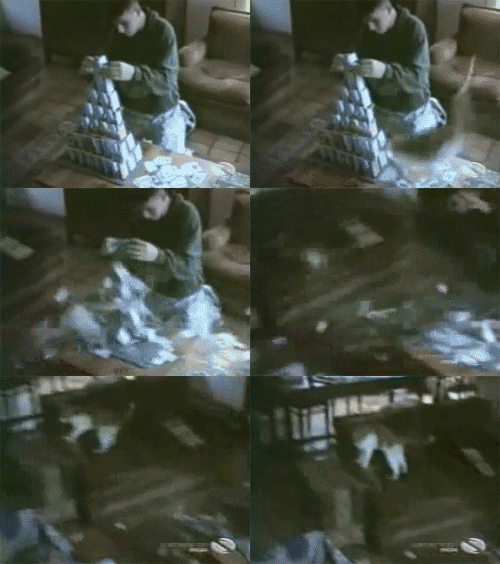
           These aren’t the kind of alterations that get rushed out overnight.  They’ll have repercussions throughout the story. They’re require other changes.  And then more revisions to make sure those changes don’t cause changes.  A good story—even a short story—is a house of cards.  I can’t just pull one out and replace it and think nothing’s going to happen when I do.  Or take ten out altogether.
            I should think long and hard about forcing a story to meet a new set of requirements.  Length, style, content, whatever they may be.  When I’m done, it may not be what it was.
            Which would suck if it was good.
            And this has turned into a much longer rant than I planned.  Apologies.
            Next time... well, I just finished a draft.  Maybe I’ll talk a little bit about that whole process.
            Until then, go write.

Tuesday, August 16, 2016

In Response To Your Query...

            Hey, a quick bonus post or Writers Coffeehouse folks.  Or any of you who are interested in such things...
            One of our Coffeehouse topics this past weekend was querying agents, and I told the folks there about how I actually got attention from two fairly well-known, high profile agents because I had a good query letter and could talk like a professional in one-on-one meetings. And I thought it might be useful to some folks to have said letter as a rough template.
            Ironically, the book I was querying with was The Suffering Map, my early novel that I use so often here as an example of how not to do things.  Seriously, I use it so often there’s a tag for it.  A big one.  You could figure out a lot of the book  just by reading about all the elements I screwed up in it.
            Anyway...
------------------------
                                                                          May 15th, 2003
                                                                          My Old Address
                                                                          San Diego CA 92116
Name
Agency
Address
New York NY

Ms. ########,

            If you could travel in an instant to anywhere, or any-when, in the world, where would you go?  Now, what if there was a price?  What if each journey submitted you to a nightmare of pain and torture before you arrive, unharmed, without a mark on you, at your destination.  Getting there is not half the fun.  So why would Rob Fable do it a second time?  Or a third?  And what would happen if he got addicted to it?

My novel, THE SUFFERING MAP,  is a suspense/ horror novel that also involves a great deal of mythology, history, and a sprinkling of pop culture.  It's set in my home city of San Diego, and the title refers to a mysterious device, found (well, stolen) by Rob, which allows him to travel while submitting him to the whims of a being called Bareback.  It also brings him into contact with Sondra, who develops an unusual bond with the Suffering Map, and Gulliver, who has his own plans for the mechanism....

        Rob comes to realize the financial potential of the device and travels with it more and more.  When he discovers some of the historical results of using the Suffering Map, though, he finds it isn't that easy to stop using it.  In the end, Rob must come to terms with his addiction to the ancient machine as his friends try to save him and themselves, for Bareback has his own plans, and the power of history is on his side.

            I would like to send you either the full manuscript of The Suffering Map (approximately 120,000 words), or some sample chapters and a synopsis, at your preference.  Please find a SASE enclosed for your convenience.

                                                                          Sincerely,

                                                                          Peter Clines
-----------------------

            So, look at what we’ve got here. First off, it’s short and simple--one page only.  I introduce the four major characters and explain the title.  Also notice that while pretty much the whole thing is talking about the story--this could almost be a back of the book/inside flap description,  I also slip in a bit of humor (okay, maybe he didn’t find the Suffering Map...) and some credentials (I’m not just writing about a city I’ve never been to or visited once).
            I wrap it up with a professional closing.  At the time this particular agent hadn’t set out firm guidelines past “query first,” so I suggested some options, each one showing that I have an understanding of the process.  By offering the full manuscript (with a word count) I’m confirming it’s done, and I have an idea how long such a book should be.  Offering a synopsis implies I either have one ready or know how to prepare one.  And all of that helps show that I’ve got an idea how to use words to convey ideas.  Y'know, like a writer...
            One more thing. The little device of asking questions—good, semi-rhetorical questions—encourages people to consider answers.  So even though I address these questions a bit later (to some degree), I’m still leaving room for the agent to wonder about what the answer is. The Suffering Map, as implied, has a mystery element to it, so questions worked well for me. YMMV.
            However... I hear that "asking rhetorical questions" has been getting used in queries a lot lately, and the device is bordering on gimmicky.  Most agents hate gimmicks, because even though it may be new and clever to me, odds are they've seen it a hundred times.  This week.  Some might just roll their eyes and keep reading, for others it may be a dealbreaker.  So be cautious with gimmicks.  Or something that may be bordering on gimmick-hood.
            And, again, please don’t forget—this is an example of what worked for me. Your individual query letter needs to reflect your book and your skills as a writer, so copying this and making minor tweaks won’t really help.  This is just a guide, so when you’re talking about your book you’ll have a sense of what to say.
            On our regularly-scheduled Thursday post, I wanted to talk about sucker punches.
            Until then, go write.
            And if you’re at that stage... query.

Thursday, June 23, 2016

Rejected by Inspector #12

            If I can shamelessly namedrop a bit,  I heard a great Richard Matheson quote from Jonathan Maberry a while back, which I will now paraphrase as such.
            Writing is the art of telling stories.  Publishing is the business of selling as many copies of that art as possible.
            If you break it down, this collection of rants is probably 98% about writing, maybe 2% about publishing.  This week, if I may, I’d like to step away from the straight writing stuff that I normally do and touch on an issue more on the publishing side of things.
            Nobody here likes getting rejected. Not for an apartment, not for a job, not for a date. Definitely not for our writing.  But that's life. Rejection happens all the time, even to the folks who get considered professionals.  I had a short story rejected from an anthology last year.  I’ve been trying to pitch a book trilogy to my editor for two years now, and he’s just not interested. Heck, my agent’s not even that interested in it.  These things happen.
            I bring this up because there’s a meme, or sometimes an article, that floats around a lot, presenting a bunch of facts that go something like this... 
            “Famous writer X showed their manuscript Y to twenty-three editors before someone bought it.  Not only that, bestselling novel Y2 by famous writer X2 was rejected by forty-two editors. Can you imagine that? Forty-two people passed on Y2?  Ha ha ha, how many of them are kicking themselves now?”
            This list can be ten or fifteen authors/books long, and I see it get used a lot to show how A) I shouldn’t give up hope just because of all my rejections, B) editors don’t know anything, C) the publishing industry is a dinosaur that’s going to die out any day now, just wait and see, or D) all of the above.
            So, at first glance, this list can seem like a really awesome thing. It makes me feel more positive about rejection.  It makes me feel more positive about that stupid editor’s decision.  It validates my feelings about big publishing and their ongoing habit of ignoring my letters.  And this is good, right?
            Thing is, there’s three problems here.  And I think they cause more issues than all this positive affirmation solves.  Y’see, Timmy, this list isn’t as clear-cut as it seems...
            First problem is the false parallel that often gets drawn because of this list.  Carrie was rejected many times and my early book-- The Suffering Map --was rejected many times.  Therefore, logically, my book must be just as good (and just as worthy of being published) as Stephen King’s breakout hit.
            We can all see the flaw there, right?  Just because an editor rejected a good book doesn’t mean all the books they reject are good. Some of them—let’s be honest—some of them are not good.  Some of them are bad.  We can all probably name one or two folks who aren’t as good at writing as they think they are.  And they can probably name two or three folks, too.
            I can freely admit, I’ve had books rejected by agents.  And they deserved to be rejected.  They were awful.  Honestly, in retrospect, I’m kind of ashamed I submitted one of them. 
            The next problem, to be blunt, is that writers don’t always send stories where they’re supposed to go.  Sometimes we get overeager or don’t do all the research we should.  If I’d sent Ex-Heroes to Harlequin, of course they would’ve rejected it. So would the Black Library (a very specific niche press), Razorbill (a young adult press), or Lonely Planet (a travel book publisher).  Getting rejected from these places would be completely understandable, but would it really say anything about the quality of my writing?  Or that editor's ability to recognize good writing?
            So should I consider those when I say that my book’s been rejected half a dozen times?
            Heck, a while back I spoke with a woman online as she lamented that her story had been rejected four times.  Ignoring the fact that four times is nothing, it turned out she’d submitted to four radically different markets.  She’d tried marketing it as young adult, sci-fi, fantasy, and as a horror novel.  Which really meant she’d been rejected once.  Once as a young adult story, once as a sci-fi story, and so on.
            Is that worth calling it quits over?
            Also, there are some writers out there who... well, who can’t take a hint.  They’re the literary equivalent of the guy who thinks if he keeps asking Phoebe out every Friday night, eventually she’ll break down and say yes. When an editor rejects a manuscript... that’s it.  Unless they specifically ask to see it again, I shouldn’t try to sneak it back in their pile six months later. No, not even if I explain that I tweaked three of the chapters. My goal is to convince them I’m a professional, and that’s not how professionals work.  But some people do it anyway, often the folks who tend to do “carpet bomb” submissions of twenty or thirty editors at a time.
            If Phoebe rejects my advances twenty times, is that twenty rejections?  Or is it just one (and I’m really bad at taking a hint)?
            So rejection numbers don’t necessarily tell a complete story.
            Finally, this list implies a really big misconception, something a lot of beginners (or willfully uninformed folks) don’t get.  When they hear that bestselling author Wakko Warner was rejected thirty times, they make the assumption that Wakko sent out the exact same book with the exact same query letter thirty times.  Thirty editors all saw the same book that got published, letter for letter, and every one of them passed on it.
            As someone who’s made those rounds, I’d be willing to bet some serious cash that’s not true.
            After a given number of rejections, a good writer’s going to take note that something isn’t working.  It might be a low number, just two or three.  It might be as high as a dozen.  But only a really deluded person is going to keep doing the exact same thing again and again and expect the results are going to radically change.
          Personally, I’d rewrite my cover letter after every fourth or fifth rejection.  Sometimes it would be to update it with a new sale or credit.  Other times I’d come up with a cleaner, slicker way to get a point across.  All too often, it was to fix the typo that had slipped past three revisions and didn’t get noticed until after I sent things out.   Whatever made me do it, it was rare for more than a handful of editors to get the exact same letter from me.  And  different people interpret those letters different ways
            Not only that, if I was lucky enough to get any sort of feedback... I listened to it.  I didn’t always follow it word for word, but if the people who were in the position to buy my stories offered suggestions, I considered them.  The Suffering Map went through a pretty decent revision halfway through my submissions, and then another one right after I attended the SDSU Writers’ Conference. 
            Out of its dozen or so submissions, I’d guess at least three different versions of it went out under three or four different cover letters.
            So, with all of this in mind...  is it that amazing a particular book was rejected forty-two times? 
            It seems kind of, well, normal, doesn’t it?
            It’s always fantastic to look back at the people who inspired us and how they got their start.  If I want to walk that same path, though, I need to look at that start without any blinders or preconceptions. Which is going to make the path look a lot tougher.
            But it’ll also make it easier to follow.
            Next time...
            I don’t know. Between the ranty blog and the Writers Coffeehouse, it feels like I’ve been going on and on about so many things, it all feels a bit repetitive to me.  Is there an appropriate writing topic anybody’d like to hear me babble on about?
            If not... I’ll put something together...
            Until then, go write.

Thursday, February 18, 2016

My Dream Woman

            First, before I forge...  Folks in the Los Angeles area, this weekend is the Writers Coffeehouse.  Sunday, noon to three, at Dark Delicacies in Burbank. It’s free and it’s open to writers of all levels—from bare-bones beginners to seasoned professionals, and even a few mid-list hacks like myself.  Stop by, ask questions, have fun.
            Speaking of writing advice...
            This week I wanted to prattle on for a moment about one of those off-topics I tend not to talk about much.  It's more of a mindset, and it applies to writers of prose and scripts alike.  I’ll give you a hint—it’s not a good mindset to have.
            Let me toss out a hypothetical situation for you.  More exact, a hypothetical person.  I'll call her Phoebe.  If you want to substitute a different name or gender, please go right ahead.
            Just for the record, I have never known a Phoebe. I know two or three folks who’ve changed their names, and they weren’t a Phoebe before or after.  That’s why it’s one of my four fallback names I use here all the time (the other three belonging to the Animaniacs).  If I randomly referred to a woman in one of these examples as Colleen, Becky, Jennifer, or Katie, for example... I would get many calls/messages from people I know asking “is this supposed to be me?” 
            So... Phoebe.
            Phoebe is, for the record, my dream woman.  She's what every man aspires to in a significant other.  Smart.  Funny.  Kind.  Sexy.  Gorgeous.  I can't think of anything I've wanted more than to be with Phoebe. Feel free to take "be with" any way you like--you'll be right.  She is, in all ways, perfect.
            Well, perfect might be overstating it. 
            Just a bit.
            To be honest, she could use one tiny improvement in the facial region.  Her chin is kind of sharp.  Makes her face a bit too triangular and pointy.  A rounded chin would bring out her cheeks and her smile more.
            Also... slight overbite.  You can't really notice it until you're close to her.  That's when you can also see one of her incisors has this little twist to it.  Nothing braces couldn't fix, though.  Maybe those transparent ones.  Invisalign?  Something like that.
            Plus, she'd be much hotter if her hair was a bit lighter.  And not so long.  If she was more of a platinum blonde, Phoebe would be unbelievably hot.  So really she's just a haircut and a box of dye away from being my perfect woman.
            Speaking of which—please don't judge me for this—Phoebe is a touch on the small side.  Not flat, by any means, and they're nicely formed.  Really nice.  I'm not talking about anything grotesque, mind you, but something in a B-cup would give her an absolutely killer figure. 
            Again, though, that's minor.  Really minor.  Heck, I think it's just outpatient surgery these days.
           Y'know, thinking about it, if she wore some nicer clothes, it'd help show off that figure, too.  Everything Phoebe owns is that kind of frumpy-baggy look.  It was kind of cute in college, but come on.  Dress up a bit now and then.  Would it be so wrong to wear something eye-catching?  Once we're together, I’ll take her on a nice shopping spree before we go out anywhere.
            Although I don't know where we'll go out.  We don't have many of the same interests. She can’t stand superhero movies.  Or shows.  Or books (which is a bit of a sore spot).  I'll work on that, get her to watch something better and stop subjecting me to that crap stuff she likes to watch.
            And, I mean... I sit in a chair nine hours a day and she makes me look kind of athletic. She’s still got that young metabolism, lets her eat half a pizza before bed and she actually wakes up weighing less than she did the night before.  That’s not going to last forever.
            At least, with that body—well, the potential body we’re talking about—the sex will be worth it. 
            As long as she doesn't make that same weird noise she makes when she's excited.  That sound creeps me out.
            Still my dream girl, though, and I'd love to be with her—in any sense of the phrase.
            So, at this point I can guess what a lot of you are thinking.  Why the hell is Phoebe my dream girl?  She sounds like a good, solid person as she is, but it's pretty apparent she's not what I'm looking for, despite my insistence that I want to be with her.  I mean, why would anyone want to be involved with someone just to change everything about them?
            Which... is the point I wanted to make.
            Between this ranty blog, conventions, signings, Twitter, Facebook, the Coffeehouse I mentioned up above... I meet a lot of writers.  Several of them are so far past me I’m astonished when they strike up a conversation.  A couple...I think it’s safe for me to say I’m on the same level as them.
            Most of them are beginners, though.   Maybe they’ve got a small sale under their belt, but often not even that much.  You probably know some folks like this, yes?  Maybe you’re one of them.  These folks will talk about how much they want to be writers, how it's been a lifelong dream to see their name on a shelf in a bookstore, or to hear actors reciting their dialogue.  There's nothing they want more, and they'll do whatever it takes, to make that dream become a reality.
            However...
            Just after this, some of these folks follow it up by explaining how biased and unfair the publishing industry is.   Or maybe listing off all the things that are wrong with Hollywood.  Don't even get these folks started on agents.  Agents of all types need to be a lot more open, especially considering they usually do nothing and then take a cut of your money.
            Or maybe they swing the other way.  Perhaps they’ll  point out how much self-publishers are screwing things for everybody. It’s not even real publishing, right?  They’re just oversaturating the markets with all their crap and making it harder for good stuff—my stuff—to get noticed.
            As a finale, these people will announce all the things they'd change about the industry.  All the things they're going to change once they're in that position of power.  In fact, the industry's changing now and they'd better watch out!  We don’t need any of those dinosaurs anymore, right?!
            By what I'm sure is a complete coincidence, very, very few of these people have ever sold a book.  Or a screenplay.  Or a short story.  
            Which only shows how corrupt and broken the system is and why it needs to be fixed.  Right?
            Y'see, Timmy, I can’t go into any sort of relationship thinking I’ll be the one to change her!  Or him.  Or them, if I’m feeling adventurous.  Those relationships are always doomed one way or another.  Either they fail horribly or they “succeed” with one person or the other becomes a twisted, compromised version of themselves (and probably hating the other person for it).
            Likewise, I can't expect to have any sort of success in the publishing world or in Hollywood if I’m starting from the mindset of “they're all wrong.”  Definitely not if it’s my main focus.  It's no different than my mad pursuit of Phoebe just so I can change everything about her.  I’m either looking for a relationship or I’m looking for someone to be my Eliza Doolittle-esque test subject.
            My main focus as a writer should be (ready for this?) my writing.  It needs to be my main concern.  It’s very good to know about different forms of publishing, about marketing and networking and social media... but first and foremost, I’m a writer.  Personally, when someone introduces themselves as a writer and the first thing they want to talk about is everything wrong with traditional publishing... I get a little cautious.
            What’s your first concern?  Do you want to date Phoebe... or do you just want everything on your terms? 
            Next time...
            Oh, almost forgot!  This Tuesday, Ex-Isle is finally out on audiobook after delays that are pretty solidly my fault.  And they brought back the whole cast for the production.  Check it out!
            So... next time, if I may, I’d like to talk about your purpose.
            Until then... go write.